You are given a metaphase chromosome preparation (a slide) from an unknown organism that contains 12 chromosomes. Two that are clearly smaller than the rest appear identical in length and centromere placement. Describe all that you can about these chromosomes.
Verified step by step guidance
1
Step 1: Identify the total chromosome number and note the presence of two smaller chromosomes that are identical in length and centromere position. This suggests these two chromosomes may be homologous pairs or possibly sex chromosomes if the organism is diploid.
Step 2: Understand that chromosomes identical in length and centromere placement are likely homologous chromosomes, meaning they carry the same genes but may have different alleles. This is typical in diploid organisms where chromosomes come in pairs.
Step 3: Consider the significance of the smaller size of these two chromosomes compared to the others. Smaller chromosomes may carry fewer genes or represent specialized chromosomes such as sex chromosomes or microchromosomes, depending on the organism.
Step 4: Recognize that the centromere placement (metacentric, submetacentric, acrocentric, or telocentric) helps classify chromosome morphology, which can be used to identify chromosome pairs and understand their behavior during cell division.
Step 5: Conclude that from the metaphase spread, you can describe the chromosome number (12), the presence of a pair of smaller homologous chromosomes, their morphology based on centromere position, and hypothesize about their genetic significance, but further analysis (e.g., banding patterns or molecular markers) would be needed for detailed identification.
Verified video answer for a similar problem:
This video solution was recommended by our tutors as helpful for the problem above
Video duration:
2m
Play a video:
Was this helpful?
Key Concepts
Here are the essential concepts you must grasp in order to answer the question correctly.
Chromosome Structure and Morphology
Chromosomes are composed of DNA and proteins, with distinct regions such as the centromere that influence their shape. The position of the centromere classifies chromosomes as metacentric, submetacentric, or acrocentric, which helps in identifying and comparing chromosomes based on size and shape.
In diploid organisms, chromosomes exist in homologous pairs, each inherited from one parent. Identical length and centromere placement suggest the two smaller chromosomes are homologs, meaning they carry the same genes but may have different alleles.
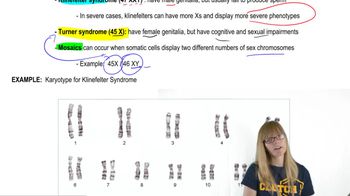
Karyotyping involves arranging chromosomes by size and centromere position to analyze chromosome number and structure. Observing 12 chromosomes with two smaller identical ones allows inference about the organism’s chromosome count, potential sex chromosomes, or presence of autosomes.