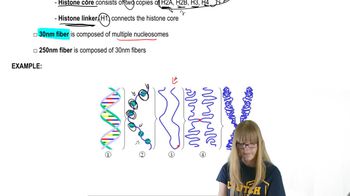
Describe the 'folded-fiber' model of the mitotic chromosome.
Verified step by step guidance
1
Begin by explaining that the 'folded-fiber' model describes how chromatin fibers are compacted during mitosis to form highly condensed mitotic chromosomes.
Describe that in this model, the 30 nm chromatin fiber undergoes successive folding and looping, creating higher-order structures that progressively compact the DNA.
Explain that these folds and loops are organized in a hierarchical manner, where smaller loops fold into larger loops, contributing to the overall chromosome architecture.
Mention that this folding allows the chromosome to be densely packed while still maintaining accessibility for essential processes like segregation during mitosis.
Conclude by noting that the folded-fiber model contrasts with simpler linear or solenoid models by emphasizing dynamic folding and looping as key to chromosome condensation.
Verified video answer for a similar problem:
This video solution was recommended by our tutors as helpful for the problem above
Video duration:
1m
Play a video:
Was this helpful?
Key Concepts
Here are the essential concepts you must grasp in order to answer the question correctly.
Chromosome Structure
Chromosomes are highly organized structures of DNA and proteins that ensure accurate DNA packaging and segregation during cell division. Understanding their hierarchical organization, from DNA double helix to chromatin fibers and higher-order folding, is essential to grasp models of chromosome architecture.
The folded-fiber model proposes that mitotic chromosomes are formed by folding and looping of chromatin fibers into compact structures. This model emphasizes hierarchical folding of 30 nm chromatin fibers into larger loops and coils, explaining the dense packing observed in mitotic chromosomes.
During mitosis, chromosomes undergo condensation to become visible and manageable for segregation. This process involves protein complexes like condensins that facilitate chromatin folding and stabilization, which is a key aspect underlying the folded-fiber model's explanation of chromosome compaction.