Describe the basis for chromosome mapping in the Hfr x F⁻ crosses.
Verified step by step guidance
1
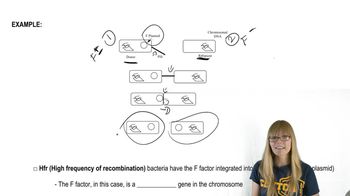
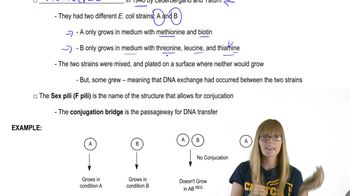
Understand that chromosome mapping in Hfr x F⁻ crosses is based on the process of conjugation, where an Hfr (high frequency recombination) strain transfers part of its chromosomal DNA to an F⁻ (female) recipient cell.
Recognize that during conjugation, the transfer of genes from the Hfr donor to the F⁻ recipient occurs in a linear and sequential manner starting from the origin of transfer on the Hfr chromosome.
Note that the time it takes for specific genes to be transferred can be measured by interrupting conjugation at various time points, which allows determination of the order of genes on the chromosome.
Use the timing data to construct a genetic map, where the relative distances between genes are proportional to the time required for their transfer; genes transferred earlier are closer to the origin of transfer.
Understand that this method allows researchers to map the position and order of genes on the bacterial chromosome based on the frequency and timing of recombination events during Hfr x F⁻ conjugation.
Verified video answer for a similar problem:
This video solution was recommended by our tutors as helpful for the problem above
Video duration:
1m
Play a video:
Was this helpful?
Key Concepts
Here are the essential concepts you must grasp in order to answer the question correctly.
Hfr and F⁻ Bacterial Strains
Hfr (High frequency recombination) strains have the F factor integrated into their chromosome, enabling them to transfer chromosomal genes during conjugation. F⁻ strains lack the F factor and serve as recipients in these crosses, allowing study of gene transfer and mapping.
Conjugation is a process where genetic material is transferred from an Hfr donor to an F⁻ recipient through direct contact. The transfer starts at the integrated F factor origin and proceeds linearly, allowing sequential gene transfer that reflects gene order on the chromosome.
Chromosome mapping in Hfr x F⁻ crosses is based on timing gene entry during conjugation. By interrupting mating at various times, researchers determine the order and relative distances of genes on the chromosome, constructing a genetic map based on transfer times.