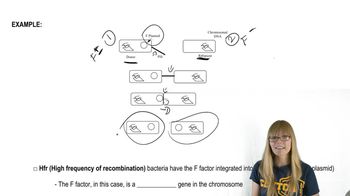
Describe the basis for chromosome mapping in the Hfr x F⁻ crosses.
Table of contents
- 1. Introduction to Genetics51m
- 2. Mendel's Laws of Inheritance3h 37m
- 3. Extensions to Mendelian Inheritance2h 41m
- 4. Genetic Mapping and Linkage2h 28m
- 5. Genetics of Bacteria and Viruses1h 21m
- 6. Chromosomal Variation1h 48m
- 7. DNA and Chromosome Structure56m
- 8. DNA Replication1h 10m
- 9. Mitosis and Meiosis1h 34m
- 10. Transcription1h 0m
- 11. Translation58m
- 12. Gene Regulation in Prokaryotes1h 19m
- 13. Gene Regulation in Eukaryotes44m
- 14. Genetic Control of Development44m
- 15. Genomes and Genomics1h 50m
- 16. Transposable Elements47m
- 17. Mutation, Repair, and Recombination1h 6m
- 18. Molecular Genetic Tools19m
- 19. Cancer Genetics29m
- 20. Quantitative Genetics1h 26m
- 21. Population Genetics50m
- 22. Evolutionary Genetics29m
5. Genetics of Bacteria and Viruses
Bacterial Conjugation
Problem 11
Textbook Question
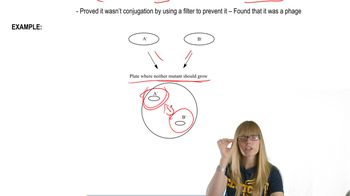
Explain the observations that led Zinder and Lederberg to conclude that the prototrophs recovered in their transduction experiments were not the result of F⁺ mediated conjugation.
Verified step by step guidance1
Understand the context: Zinder and Lederberg were studying genetic exchange in bacteria, specifically looking at how prototrophic bacteria (those able to grow without added nutrients) appeared after mixing auxotrophic strains (those requiring supplements). They wanted to determine whether this exchange was due to conjugation (F⁺ mediated) or another mechanism.
Recall the key observation: In their experiments, prototrophs appeared even when the donor and recipient bacteria were separated by a filter that prevented direct cell-to-cell contact but allowed passage of phage particles or small molecules.
Analyze the implication of the filter experiment: Since F⁺ mediated conjugation requires direct contact between bacterial cells to transfer genetic material, the appearance of prototrophs despite the physical barrier suggested that conjugation was not responsible for the genetic exchange.
Consider the role of bacteriophages: Zinder and Lederberg proposed that a virus (a bacteriophage) was mediating the transfer of genetic material between bacteria, a process now known as transduction. This explained how genetic material could move without direct cell contact.
Summarize the conclusion: The key evidence was that prototrophs were recovered even when conjugation was physically blocked, leading to the conclusion that the genetic exchange was mediated by a phage, not by F⁺ mediated conjugation.
Verified video answer for a similar problem:This video solution was recommended by our tutors as helpful for the problem above
Video duration:
1mPlay a video:
Was this helpful?
Key Concepts
Here are the essential concepts you must grasp in order to answer the question correctly.
Bacterial Conjugation and F⁺ Factor
Bacterial conjugation is a process where genetic material is transferred between bacteria through direct contact, often mediated by the F⁺ plasmid. The F⁺ factor enables the donor cell to form a pilus and transfer DNA to an F⁻ recipient, typically resulting in specific gene transfer patterns. Understanding this mechanism is essential to distinguish conjugation from other gene transfer methods.
Recommended video:
Guided course
F Factor and Hfr
Transduction as a Mechanism of Gene Transfer
Transduction involves the transfer of bacterial DNA from one cell to another via bacteriophages (viruses that infect bacteria). Unlike conjugation, transduction does not require cell-to-cell contact and can transfer chromosomal genes accidentally packaged into phage particles. Recognizing transduction helps explain gene transfer events that occur independently of the F⁺ factor.
Recommended video:
Guided course
Transduction
Experimental Evidence Differentiating Transduction from Conjugation
Zinder and Lederberg observed that prototrophs appeared even when physical contact between donor and recipient cells was prevented, ruling out conjugation. Additionally, the transfer was sensitive to treatments affecting phages but not conjugation machinery. These observations indicated that gene transfer occurred via transduction, not F⁺ mediated conjugation.
Recommended video:
Guided course
Transduction
Related Videos
Related Practice
Textbook Question
994
views
