In a recombinant DNA cloning experiment, how can we determine whether DNA fragments of interest have been incorporated into plasmids and, once host cells are transformed, which cells contain recombinant DNA?
Table of contents
- 1. Introduction to Genetics51m
- 2. Mendel's Laws of Inheritance3h 37m
- 3. Extensions to Mendelian Inheritance2h 41m
- 4. Genetic Mapping and Linkage2h 28m
- 5. Genetics of Bacteria and Viruses1h 21m
- 6. Chromosomal Variation1h 48m
- 7. DNA and Chromosome Structure56m
- 8. DNA Replication1h 10m
- 9. Mitosis and Meiosis1h 34m
- 10. Transcription1h 0m
- 11. Translation58m
- 12. Gene Regulation in Prokaryotes1h 19m
- 13. Gene Regulation in Eukaryotes44m
- 14. Genetic Control of Development44m
- 15. Genomes and Genomics1h 50m
- 16. Transposable Elements47m
- 17. Mutation, Repair, and Recombination1h 6m
- 18. Molecular Genetic Tools19m
- 19. Cancer Genetics29m
- 20. Quantitative Genetics1h 26m
- 21. Population Genetics50m
- 22. Evolutionary Genetics29m
18. Molecular Genetic Tools
Genetic Cloning
Problem 2
Textbook Question
Write a short essay or sketch a diagram that provides an overview of how recombinant DNA techniques help geneticists study genes.
Verified step by step guidance1
Begin by explaining that recombinant DNA techniques involve combining DNA from different sources to create new genetic combinations that are useful for research, medicine, and biotechnology.
Describe the process of isolating a gene of interest using restriction enzymes, which cut DNA at specific sequences, allowing geneticists to extract and manipulate specific DNA fragments.
Explain how these DNA fragments can be inserted into vectors, such as plasmids, which are circular DNA molecules that can replicate independently within bacterial cells, facilitating gene cloning.
Discuss how the recombinant DNA is introduced into host cells (transformation), enabling the replication and expression of the gene, which allows geneticists to study gene function, regulation, and protein production.
Conclude by highlighting that recombinant DNA technology enables detailed analysis of genes, including sequencing, mutagenesis, and gene therapy applications, thus providing powerful tools to understand genetics at a molecular level.
Verified video answer for a similar problem:This video solution was recommended by our tutors as helpful for the problem above
Video duration:
2mPlay a video:
Was this helpful?
Key Concepts
Here are the essential concepts you must grasp in order to answer the question correctly.
Recombinant DNA Technology
Recombinant DNA technology involves combining DNA molecules from different sources into one molecule to create new genetic combinations. This technique allows scientists to isolate, manipulate, and study specific genes by inserting them into vectors like plasmids, which can be replicated in host cells.
Recommended video:
Guided course
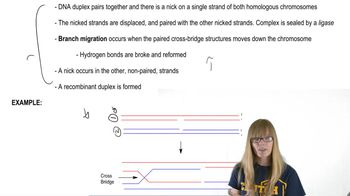
Recombination after Single Strand Breaks
Gene Cloning and Expression
Gene cloning is the process of making multiple copies of a particular gene using recombinant DNA methods. By cloning genes into host organisms, geneticists can produce large amounts of DNA or protein, enabling detailed study of gene function, regulation, and expression patterns.
Recommended video:
Guided course
Penetrance and Expressivity
Applications in Genetic Analysis
Recombinant DNA techniques facilitate various genetic analyses, such as identifying gene sequences, studying mutations, and producing genetically modified organisms. These methods help in understanding gene structure, function, and interactions, advancing research in medicine, agriculture, and biotechnology.
Recommended video:
Guided course
Chi Square Analysis
Related Videos
Related Practice
Textbook Question
516
views