Table of contents
- 1. Introduction to Genetics51m
- 2. Mendel's Laws of Inheritance3h 37m
- 3. Extensions to Mendelian Inheritance2h 41m
- 4. Genetic Mapping and Linkage2h 28m
- 5. Genetics of Bacteria and Viruses1h 21m
- 6. Chromosomal Variation1h 48m
- 7. DNA and Chromosome Structure56m
- 8. DNA Replication1h 10m
- 9. Mitosis and Meiosis1h 34m
- 10. Transcription1h 0m
- 11. Translation58m
- 12. Gene Regulation in Prokaryotes1h 19m
- 13. Gene Regulation in Eukaryotes44m
- 14. Genetic Control of Development44m
- 15. Genomes and Genomics1h 50m
- 16. Transposable Elements47m
- 17. Mutation, Repair, and Recombination1h 6m
- 18. Molecular Genetic Tools19m
- 19. Cancer Genetics29m
- 20. Quantitative Genetics1h 26m
- 21. Population Genetics50m
- 22. Evolutionary Genetics29m
2. Mendel's Laws of Inheritance
Sex-Linked Genes
Problem 1d
Textbook Question
The discussion centers on extensions and modifications of Mendelian principles and ratios. In the process, we encountered many opportunities to consider how this information was acquired. On the basis of these discussions, what answers would you propose to the following fundamental questions?
For genes whose expression seems to be tied to the sex of individuals, how do we know whether a gene is X-linked in contrast to exhibiting sex-limited or sex-influenced inheritance?
Verified step by step guidance1
Step 1: Understand the definitions of the three inheritance patterns: X-linked inheritance involves genes located on the X chromosome; sex-limited inheritance refers to traits expressed only in one sex despite the gene being present in both; sex-influenced inheritance means the trait expression differs between sexes due to hormonal or physiological differences.
Step 2: Examine the pedigree patterns for clues: In X-linked inheritance, affected males often have carrier or affected mothers, and the trait typically shows different transmission patterns between males and females, such as no male-to-male transmission.
Step 3: For sex-limited traits, observe if the trait appears exclusively in one sex even though both sexes carry the gene, indicating that expression is restricted by sex-specific factors rather than chromosome location.
Step 4: For sex-influenced traits, look for differences in trait expression or penetrance between males and females, where the gene is autosomal but the phenotype is more common or severe in one sex due to hormonal influence.
Step 5: Use molecular or genetic testing to confirm gene location (e.g., linkage analysis or sequencing) and combine this with phenotypic data to distinguish X-linked inheritance from sex-limited or sex-influenced patterns.
Verified video answer for a similar problem:This video solution was recommended by our tutors as helpful for the problem above
Video duration:
1mPlay a video:
Was this helpful?
Key Concepts
Here are the essential concepts you must grasp in order to answer the question correctly.
X-linked Inheritance
X-linked inheritance refers to genes located on the X chromosome, which show distinct patterns of transmission and expression between males and females due to their differing sex chromosome compositions. Males (XY) express X-linked traits with only one allele, while females (XX) may be carriers or express the trait depending on dominance. Pedigree analysis often reveals characteristic inheritance patterns, such as affected males with carrier mothers.
Recommended video:
Guided course
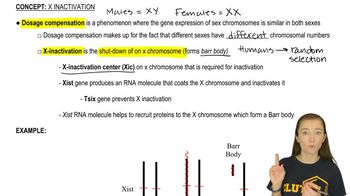
X-Inactivation
Sex-limited Inheritance
Sex-limited inheritance involves genes present in both sexes but expressed only in one sex due to physiological or hormonal differences, such as genes controlling milk production in female mammals. These traits do not follow typical Mendelian ratios because expression is restricted to one sex, despite both sexes carrying the gene.
Recommended video:
Guided course
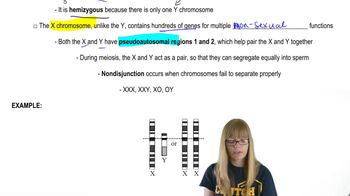
Sex-Linked Genes
Sex-influenced Inheritance
Sex-influenced inheritance describes traits where gene expression differs between sexes, often due to hormonal effects, causing a dominant allele in one sex to be recessive in the other. For example, a gene may cause baldness dominantly in males but recessively in females, leading to different phenotypic ratios in males and females despite the gene being autosomal.
Recommended video:
Guided course
Sex-Linked Genes
Related Videos
Related Practice
Multiple Choice
If five males inherit an X-linked recessive allele from their carrier mothers, what is the expected phenotype of these males?
18
views
