Outline the current model for DNA synthesis.
Table of contents
- 1. Introduction to Genetics51m
- 2. Mendel's Laws of Inheritance3h 37m
- 3. Extensions to Mendelian Inheritance2h 41m
- 4. Genetic Mapping and Linkage2h 28m
- 5. Genetics of Bacteria and Viruses1h 21m
- 6. Chromosomal Variation1h 48m
- 7. DNA and Chromosome Structure56m
- 8. DNA Replication1h 10m
- 9. Mitosis and Meiosis1h 34m
- 10. Transcription1h 0m
- 11. Translation58m
- 12. Gene Regulation in Prokaryotes1h 19m
- 13. Gene Regulation in Eukaryotes44m
- 14. Genetic Control of Development44m
- 15. Genomes and Genomics1h 50m
- 16. Transposable Elements47m
- 17. Mutation, Repair, and Recombination1h 6m
- 18. Molecular Genetic Tools19m
- 19. Cancer Genetics29m
- 20. Quantitative Genetics1h 26m
- 21. Population Genetics50m
- 22. Evolutionary Genetics29m
8. DNA Replication
Overview of DNA Replication
Problem 20d
Textbook Question
Several temperature-sensitive mutant strains of E. coli display the following characteristics. Predict what enzyme or function is being affected by each mutation.
Synthesis is very slow.
Verified step by step guidance1
Step 1: Understand the context of temperature-sensitive mutants in E. coli. These mutants have enzymes or proteins that function normally at a permissive temperature but lose function at a restrictive (higher) temperature, causing observable phenotypic changes such as slow synthesis.
Step 2: Identify what 'synthesis is very slow' refers to. In E. coli, synthesis could mean DNA replication, RNA transcription, or protein translation. Since the problem is general, consider which enzyme or function is critical for the overall synthesis process.
Step 3: Recall that DNA replication requires DNA polymerase, RNA transcription requires RNA polymerase, and protein synthesis requires ribosomes and associated factors. Slow synthesis suggests a bottleneck in one of these key enzymatic activities.
Step 4: Since the problem states 'synthesis is very slow' without specifying which type, the most likely affected enzyme is DNA polymerase if the mutation affects DNA replication, or RNA polymerase if it affects transcription. Consider which enzyme's impairment would broadly slow down synthesis.
Step 5: Conclude that the mutation likely affects an enzyme essential for nucleic acid synthesis, such as DNA polymerase or RNA polymerase, causing the observed slow synthesis phenotype at the restrictive temperature.
Verified video answer for a similar problem:This video solution was recommended by our tutors as helpful for the problem above
Video duration:
2mPlay a video:
Was this helpful?
Key Concepts
Here are the essential concepts you must grasp in order to answer the question correctly.
Temperature-Sensitive Mutations
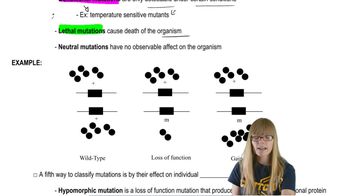
Temperature-sensitive mutations cause proteins to function normally at a permissive temperature but lose activity at a restrictive, usually higher, temperature. This allows researchers to study essential genes by observing phenotypic changes when the temperature shifts, revealing the role of the mutated enzyme or function.
Recommended video:
Guided course
Mutations and Phenotypes
Enzymes Involved in DNA Replication and Synthesis
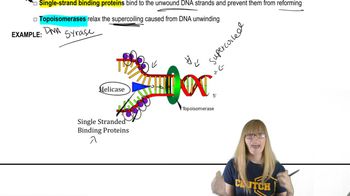
DNA synthesis in E. coli requires enzymes like DNA polymerase, helicase, primase, and ligase. Mutations affecting these enzymes can slow or halt DNA replication, leading to slow synthesis. Identifying which enzyme is impaired helps explain the observed phenotype.
Recommended video:
Guided course
Steps to DNA Replication
Phenotypic Effects of Mutations on Cellular Processes
Mutations in genes encoding enzymes involved in critical processes like DNA replication manifest as observable phenotypes, such as slow synthesis. Understanding how mutations alter enzyme function helps predict which step in the pathway is affected and the resulting cellular consequences.
Recommended video:
Guided course
Mutations and Phenotypes
Related Videos
Related Practice
Textbook Question
1005
views