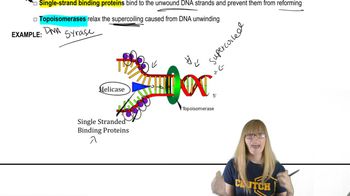
Several temperature-sensitive mutant strains of E. coli display the following characteristics. Predict what enzyme or function is being affected by each mutation. Supercoiled strands remain after replication, which is never completed.
Verified step by step guidance
1
Understand the biological context: In DNA replication, the DNA strands become supercoiled ahead of the replication fork due to the unwinding of the double helix.
Recall the role of enzymes that manage DNA supercoiling during replication. Specifically, DNA gyrase (a type of topoisomerase) introduces negative supercoils to relieve the positive supercoiling tension.
Analyze the problem statement: 'Supercoiled strands remain after replication, which is never completed.' This suggests that the enzyme responsible for relieving supercoiling is not functioning properly.
Identify that if supercoiling is not resolved, the replication machinery cannot proceed efficiently, leading to incomplete replication.
Conclude that the mutation likely affects the gene encoding DNA gyrase (topoisomerase II), which is essential for removing supercoils during replication.
Verified video answer for a similar problem:
This video solution was recommended by our tutors as helpful for the problem above
Video duration:
2m
Play a video:
Was this helpful?
Key Concepts
Here are the essential concepts you must grasp in order to answer the question correctly.
DNA Replication Process
DNA replication is the process by which a cell duplicates its DNA before cell division. It involves unwinding the double helix, synthesizing new strands, and resolving topological stress to ensure complete and accurate copying of genetic material.
DNA topoisomerases are enzymes that manage DNA supercoiling and relieve torsional strain during replication. They cut and rejoin DNA strands to prevent overwinding, allowing replication forks to progress smoothly and replication to complete.
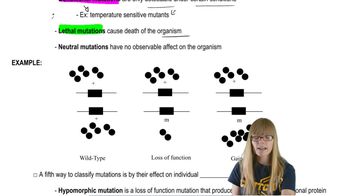
Temperature-sensitive mutations produce proteins that function normally at permissive temperatures but lose activity at restrictive (higher) temperatures. This allows study of essential genes by observing defects, such as incomplete replication due to enzyme malfunction, under non-permissive conditions.