Tryptophan regulates the trp operon by doing what?
Table of contents
- 1. Introduction to Genetics51m
- 2. Mendel's Laws of Inheritance3h 37m
- 3. Extensions to Mendelian Inheritance2h 41m
- 4. Genetic Mapping and Linkage2h 28m
- 5. Genetics of Bacteria and Viruses1h 21m
- 6. Chromosomal Variation1h 48m
- 7. DNA and Chromosome Structure56m
- 8. DNA Replication1h 10m
- 9. Mitosis and Meiosis1h 34m
- 10. Transcription1h 0m
- 11. Translation58m
- 12. Gene Regulation in Prokaryotes1h 19m
- 13. Gene Regulation in Eukaryotes44m
- 14. Genetic Control of Development44m
- 15. Genomes and Genomics1h 50m
- 16. Transposable Elements47m
- 17. Mutation, Repair, and Recombination1h 6m
- 18. Molecular Genetic Tools19m
- 19. Cancer Genetics29m
- 20. Quantitative Genetics1h 26m
- 21. Population Genetics50m
- 22. Evolutionary Genetics29m
12. Gene Regulation in Prokaryotes
Tryptophan Operon and Attenuation
Problem 1e
Textbook Question
How do we know that the trp operon is a repressible control system, in contrast to the lac operon, which is an inducible control system?
Verified step by step guidance1
Understand the basic definitions: A repressible operon is typically 'on' and actively transcribing until it is turned 'off' by a specific molecule (corepressor), whereas an inducible operon is usually 'off' and requires an inducer molecule to turn it 'on'.
Examine the trp operon: It controls the synthesis of tryptophan. When tryptophan levels are low, the operon is active, allowing the production of enzymes needed to make tryptophan. When tryptophan is abundant, it acts as a corepressor by binding to the repressor protein, enabling the repressor to bind the operator and block transcription.
Analyze the lac operon: It controls the breakdown of lactose. In the absence of lactose, the repressor binds the operator and prevents transcription. When lactose is present, it acts as an inducer by binding to the repressor, causing it to release from the operator and allowing transcription to proceed.
Compare the mechanisms: The trp operon is repressible because it is normally active and turned off by the presence of a corepressor (tryptophan), while the lac operon is inducible because it is normally inactive and turned on by the presence of an inducer (lactose).
Summarize the key difference: The trp operon responds to the end product (tryptophan) to repress gene expression, whereas the lac operon responds to the substrate (lactose) to induce gene expression.
Verified video answer for a similar problem:This video solution was recommended by our tutors as helpful for the problem above
Video duration:
1mPlay a video:
Was this helpful?
Key Concepts
Here are the essential concepts you must grasp in order to answer the question correctly.
Repressible Operon
A repressible operon is typically active but can be turned off when a specific molecule, often the end product of a pathway, binds to a repressor protein. This binding enables the repressor to attach to the operator region, blocking transcription. The trp operon is repressible because it is usually on and is turned off when tryptophan is abundant.
Recommended video:
Guided course
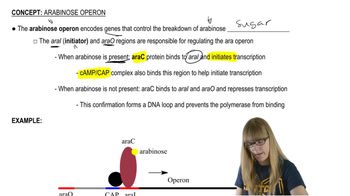
Arabinose Operon
Inducible Operon
An inducible operon is usually off and requires the presence of a specific inducer molecule to activate transcription. The inducer inactivates the repressor, allowing gene expression. The lac operon is inducible because it is off until lactose is present, which induces the operon to produce enzymes for lactose metabolism.
Recommended video:
Guided course
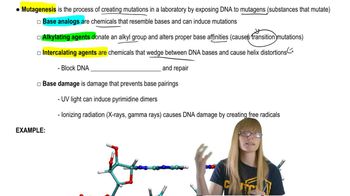
Induced Mutations
Mechanism of Gene Regulation in Operons
Operons regulate gene expression through interactions between repressors, inducers/corepressors, and operator DNA sequences. Understanding how these molecules influence RNA polymerase binding and transcription initiation is key to distinguishing repressible and inducible systems, as seen in the contrasting control of the trp and lac operons.
Recommended video:
Guided course
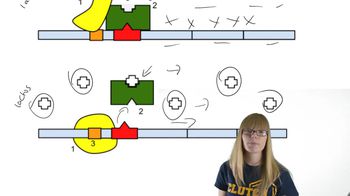
Lac Operon Regulation
Related Videos
Related Practice
Multiple Choice
795
views
3
rank