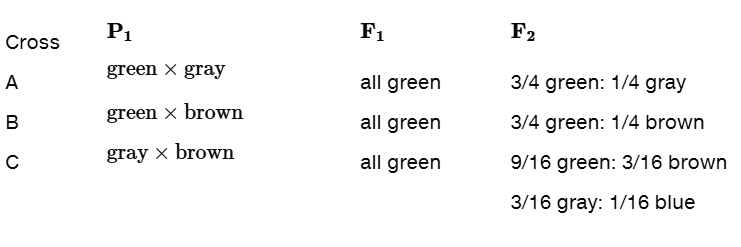
In a species of the cat family, eye color can be gray, blue, green, or brown, and each trait is true breeding. In separate crosses involving homozygous parents, the following data were obtained: In a cross between a gray-eyed cat and one of unknown genotype and phenotype, the F₁ generation was not observed. However, the F₂ resulted in the same F₂ ratio as in cross C. Determine the genotypes and phenotypes of the unknown P₁ and F₁ cats.
Verified step by step guidance
1
Step 1: Analyze the data from the given crosses to determine the inheritance pattern. Cross A (green x gray) and Cross B (green x brown) both show a 3:1 ratio in the F₂ generation, indicating that green is dominant over both gray and brown. This suggests a single-gene inheritance pattern with green being the dominant allele.
Step 2: Examine Cross C (gray x brown), which results in a 9:3:3:1 ratio in the F₂ generation. This ratio is characteristic of a dihybrid cross, indicating that two genes are involved in determining eye color. Assign alleles: let G/g represent the green/gray gene and B/b represent the brown/blue gene. Green (G) is dominant over gray (g), and brown (B) is dominant over blue (b).
Step 3: Use the F₂ ratio from Cross C to deduce the genotypes of the parents. A 9:3:3:1 ratio suggests that both parents in Cross C were heterozygous for both genes (GgBb). This means the F₁ generation from Cross C was also heterozygous (GgBb).
Step 4: For the unknown cross, note that the F₂ generation matches the 9:3:3:1 ratio observed in Cross C. This implies that the unknown parent must have contributed alleles in a way that produced a dihybrid F₁ generation. Since one parent is gray-eyed (gg), the unknown parent must have been heterozygous for both genes (GgBb) to produce the observed F₂ ratio.
Step 5: Conclude the genotypes and phenotypes. The known gray-eyed parent is ggBB or ggBb (gray phenotype). The unknown parent is GgBb (green phenotype). The F₁ generation would be GgBb (green phenotype), and the F₂ generation results from a dihybrid cross, producing the observed 9:3:3:1 ratio.
Verified video answer for a similar problem:
This video solution was recommended by our tutors as helpful for the problem above
Video duration:
3m
Play a video:
Was this helpful?
Key Concepts
Here are the essential concepts you must grasp in order to answer the question correctly.
Mendelian Genetics
Mendelian genetics is the study of how traits are inherited through generations based on the principles established by Gregor Mendel. It involves understanding dominant and recessive alleles, genotype (the genetic makeup), and phenotype (the observable traits). In this context, the inheritance patterns of eye color in cats can be analyzed using Mendel's laws, particularly the law of segregation and the law of independent assortment.
Homozygous refers to an organism having two identical alleles for a particular gene, while heterozygous means having two different alleles. In the given crosses, the homozygous parents produce predictable offspring ratios based on their alleles. Understanding whether the unknown genotype is homozygous or heterozygous is crucial for predicting the F₁ and F₂ generation outcomes.
Phenotypic ratios describe the relative frequencies of different phenotypes in the offspring resulting from a genetic cross. The ratios observed in the F₂ generation of cross C (9:3:3:1) indicate the distribution of traits based on the genotypes of the parents. Analyzing these ratios helps determine the genotypes of the unknown parent and predict the traits of the offspring in the context of the given problem.