How are the carbon and nitrogen atoms of the sugars, purines, and pyrimidines numbered?
Verified step by step guidance
1
Understand that the numbering of atoms in sugars, purines, and pyrimidines follows specific conventions important for identifying molecular structure and function in nucleic acids.
For sugars (such as ribose and deoxyribose), the carbon atoms are numbered with a prime symbol to distinguish them from atoms in the bases. The numbering starts at the carbon attached to the base and proceeds clockwise: \$1^{\prime}, 2^{\prime}, 3^{\prime}, 4^{\prime}, 5^{\prime}$.
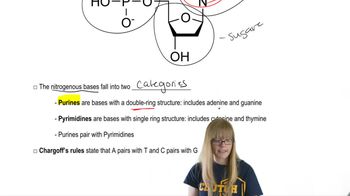
In purines (adenine and guanine), the nitrogen and carbon atoms are numbered in a fused double-ring system starting at the nitrogen at the bottom of the six-membered ring as position 1, then numbering around the six-membered ring, and continuing into the five-membered ring, up to position 9.
In pyrimidines (cytosine, thymine, and uracil), the nitrogen and carbon atoms are numbered in a single six-membered ring starting at the nitrogen at the bottom of the ring as position 1, then numbering sequentially around the ring up to position 6.
Remember that this numbering system is crucial for describing the positions of chemical groups attached to the bases and sugars, which affects base pairing and nucleic acid structure.
Verified video answer for a similar problem:
This video solution was recommended by our tutors as helpful for the problem above
Video duration:
1m
Play a video:
Was this helpful?
Key Concepts
Here are the essential concepts you must grasp in order to answer the question correctly.
Numbering of Carbon Atoms in Sugars
In nucleic acids, the sugar component (ribose or deoxyribose) has five carbon atoms numbered 1' to 5'. The numbering starts at the carbon attached to the nitrogenous base (1') and proceeds clockwise, which is essential for understanding nucleotide structure and linkage.
Purines, such as adenine and guanine, have a fused double-ring structure with nine atoms numbered from 1 to 9. This numbering is critical for identifying functional groups and understanding base pairing and molecular interactions.
Pyrimidines, including cytosine, thymine, and uracil, have a single six-membered ring with atoms numbered 1 to 6. Correct numbering helps in locating substituents and understanding the chemical behavior of these bases in nucleic acids.