List the proteins that unwind DNA during in vivo DNA synthesis. How do they function?
Verified step by step guidance
1
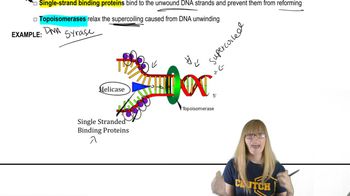
Identify the key proteins involved in unwinding DNA during in vivo DNA synthesis. These typically include helicase, single-strand binding proteins (SSBs), and topoisomerase.
Explain the role of helicase: it binds to the DNA at the origin of replication and moves along the DNA, breaking the hydrogen bonds between complementary base pairs to separate the two strands, creating the replication fork.
Describe the function of single-strand binding proteins (SSBs): after helicase unwinds the DNA, SSBs bind to the exposed single-stranded DNA to prevent the strands from re-annealing or forming secondary structures.
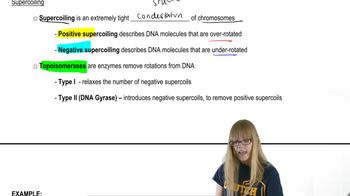
Discuss the role of topoisomerase: as helicase unwinds the DNA, it creates supercoiling tension ahead of the replication fork. Topoisomerase alleviates this tension by making temporary cuts in the DNA backbone, allowing it to unwind and then resealing the cuts.
Summarize how these proteins work together to ensure the DNA strands are properly separated and stabilized, allowing DNA polymerase to synthesize new strands efficiently.
Verified video answer for a similar problem:
This video solution was recommended by our tutors as helpful for the problem above
Video duration:
2m
Play a video:
Was this helpful?
Key Concepts
Here are the essential concepts you must grasp in order to answer the question correctly.
Helicase
Helicase is an enzyme that unwinds the DNA double helix by breaking the hydrogen bonds between complementary base pairs. This action separates the two strands, creating replication forks and allowing the DNA polymerase to access single-stranded DNA for synthesis.
Single-strand binding proteins bind to the separated DNA strands after helicase unwinds them, stabilizing the single-stranded DNA and preventing it from re-annealing or forming secondary structures. This ensures the strands remain accessible for replication.
Topoisomerase relieves the torsional strain generated ahead of the replication fork by making transient cuts in the DNA backbone. This prevents supercoiling and tangling, facilitating smooth unwinding and progression of the replication machinery.