A tumor is a growing mass of abnormal cells. What must happen for a benign tumor to become malignant?
Table of contents
- 1. Introduction to Genetics51m
- 2. Mendel's Laws of Inheritance3h 37m
- 3. Extensions to Mendelian Inheritance2h 41m
- 4. Genetic Mapping and Linkage2h 28m
- 5. Genetics of Bacteria and Viruses1h 21m
- 6. Chromosomal Variation1h 48m
- 7. DNA and Chromosome Structure56m
- 8. DNA Replication1h 10m
- 9. Mitosis and Meiosis1h 34m
- 10. Transcription1h 0m
- 11. Translation58m
- 12. Gene Regulation in Prokaryotes1h 19m
- 13. Gene Regulation in Eukaryotes44m
- 14. Genetic Control of Development44m
- 15. Genomes and Genomics1h 50m
- 16. Transposable Elements47m
- 17. Mutation, Repair, and Recombination1h 6m
- 18. Molecular Genetic Tools19m
- 19. Cancer Genetics29m
- 20. Quantitative Genetics1h 26m
- 21. Population Genetics50m
- 22. Evolutionary Genetics29m
19. Cancer Genetics
Overview of Cancer
Problem 3
Textbook Question
Where are the major regulatory points in the cell cycle?
Verified step by step guidance1
Understand that the cell cycle is divided into distinct phases: G1 (gap 1), S (DNA synthesis), G2 (gap 2), and M (mitosis). The regulatory points, also called checkpoints, ensure the cell cycle progresses correctly and prevents errors.
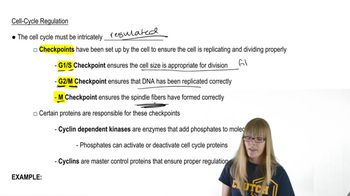
Identify the first major checkpoint at the G1/S transition, often called the 'restriction point' or 'start checkpoint.' This checkpoint assesses whether the cell has adequate nutrients, energy, and no DNA damage before committing to DNA replication.
Recognize the second major checkpoint at the G2/M transition. Here, the cell checks if DNA replication in the S phase was completed successfully and if the DNA is undamaged before entering mitosis.
Note the third checkpoint during mitosis, specifically the metaphase-to-anaphase transition, called the spindle assembly checkpoint. This checkpoint ensures that all chromosomes are properly attached to the spindle fibers before chromosome separation.
Summarize that these checkpoints are controlled by regulatory proteins such as cyclins and cyclin-dependent kinases (CDKs), which coordinate progression through the cell cycle phases.
Verified video answer for a similar problem:This video solution was recommended by our tutors as helpful for the problem above
Video duration:
57sPlay a video:
Was this helpful?
Key Concepts
Here are the essential concepts you must grasp in order to answer the question correctly.
Cell Cycle Phases
The cell cycle consists of distinct phases: G1 (growth), S (DNA synthesis), G2 (preparation for mitosis), and M (mitosis). Understanding these phases is essential because regulatory points control progression between them to ensure proper cell division.
Recommended video:
Guided course
Bacteriophage Life Cycle
Checkpoints in the Cell Cycle
Checkpoints are control mechanisms that monitor and regulate the progression of the cell cycle. The major checkpoints occur at G1/S, G2/M, and during metaphase of mitosis, ensuring DNA integrity and proper chromosome alignment before the cell proceeds.
Recommended video:
Guided course
Bacteriophage Life Cycle
Role of Cyclins and Cyclin-Dependent Kinases (CDKs)
Cyclins and CDKs are proteins that regulate the cell cycle by activating or inhibiting progression at checkpoints. Their fluctuating levels and activity ensure that cells only move to the next phase when conditions are favorable and DNA is undamaged.
Recommended video:
Guided course
Mitosis Regulation
Watch next
Master Cancer Characteristics with a bite sized video explanation from Kylia
Start learningRelated Videos
Related Practice
Textbook Question
650
views