Penetrance measures which of the following?
Table of contents
- 1. Introduction to Genetics51m
- 2. Mendel's Laws of Inheritance3h 37m
- 3. Extensions to Mendelian Inheritance2h 41m
- 4. Genetic Mapping and Linkage2h 28m
- 5. Genetics of Bacteria and Viruses1h 21m
- 6. Chromosomal Variation1h 48m
- 7. DNA and Chromosome Structure56m
- 8. DNA Replication1h 10m
- 9. Mitosis and Meiosis1h 34m
- 10. Transcription1h 0m
- 11. Translation58m
- 12. Gene Regulation in Prokaryotes1h 19m
- 13. Gene Regulation in Eukaryotes44m
- 14. Genetic Control of Development44m
- 15. Genomes and Genomics1h 50m
- 16. Transposable Elements47m
- 17. Mutation, Repair, and Recombination1h 6m
- 18. Molecular Genetic Tools19m
- 19. Cancer Genetics29m
- 20. Quantitative Genetics1h 26m
- 21. Population Genetics50m
- 22. Evolutionary Genetics29m
3. Extensions to Mendelian Inheritance
Penetrance and Expressivity
Problem 31
Textbook Question
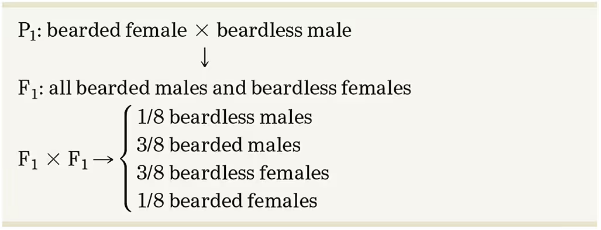
In goats, the development of the beard is due to a recessive gene. The following cross involving true-breeding goats was made and carried to the F₂ generation:

Offer an explanation for the inheritance and expression of this trait, diagramming the cross. Propose one or more crosses to test your hypothesis.
Verified step by step guidance1
Step 1: Define the alleles and their inheritance pattern. Since the beard trait is recessive, let 'b' represent the recessive allele for beard and 'B' the dominant allele for no beard. The bearded phenotype corresponds to the homozygous recessive genotype 'bb', and the beardless phenotype corresponds to either 'BB' or 'Bb'.
Step 2: Analyze the P₁ cross. The P₁ cross is between a bearded female (bb) and a beardless male. Since all F₁ males are bearded and all F₁ females are beardless, this suggests a sex-linked pattern of inheritance, likely X-linked, where the beard gene is on the X chromosome. Assign 'X^b' for the X chromosome carrying the beard allele and 'X^B' for the beardless allele. The male is XY, so the male parent is 'X^B Y' (beardless), and the female parent is 'X^b X^b' (bearded).
Step 3: Diagram the F₁ generation. Crossing 'X^b X^b' female with 'X^B Y' male produces F₁ females 'X^b X^B' (heterozygous, beardless) and F₁ males 'X^b Y' (hemizygous recessive, bearded). This matches the observation that all F₁ males are bearded and all F₁ females are beardless.
Step 4: Analyze the F₁ × F₁ cross. Crossing F₁ females 'X^b X^B' with F₁ males 'X^b Y' will produce the F₂ generation with the following genotypes and phenotypes: males 'X^b Y' (bearded) and 'X^B Y' (beardless), females 'X^b X^b' (bearded) and 'X^b X^B' (beardless). Calculate the expected ratios based on this cross.
Step 5: Propose test crosses to confirm the hypothesis. For example, cross a bearded male (X^b Y) with a beardless female (X^B X^B) and observe the offspring phenotypes. Alternatively, cross a beardless female heterozygote (X^b X^B) with a bearded male (X^b Y) and analyze the progeny ratios to confirm X-linked recessive inheritance.
Verified video answer for a similar problem:This video solution was recommended by our tutors as helpful for the problem above
Video duration:
1mPlay a video:
Was this helpful?
Key Concepts
Here are the essential concepts you must grasp in order to answer the question correctly.
Sex-Linked Inheritance
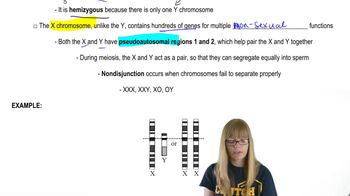
Sex-linked inheritance refers to genes located on sex chromosomes, typically the X chromosome, which results in different inheritance patterns between males and females. In this case, the beard trait shows different expression in males and females, suggesting it is linked to the sex chromosomes, with males and females inheriting and expressing the trait differently.
Recommended video:
Guided course
Sex-Linked Genes
Recessive Alleles and Phenotypic Expression
A recessive allele requires two copies (homozygous recessive) to express the trait in females, but in males, who have only one X chromosome, a single recessive allele can cause expression. This explains why all F1 males are bearded (hemizygous recessive) while females are beardless, indicating the beard gene is recessive and sex-linked.
Recommended video:
Guided course
Penetrance and Expressivity
Test Cross and Genetic Cross Diagramming
A test cross involves breeding an individual with a known genotype to a homozygous recessive to determine unknown genotypes. Diagramming the cross using Punnett squares helps visualize allele segregation and predict offspring ratios, which is essential to confirm hypotheses about inheritance patterns, such as the sex-linked recessive nature of the beard trait.
Recommended video:
Guided course
Trihybrid Cross
Watch next
Master Penetrance and Expressivity with a bite sized video explanation from Kylia
Start learningRelated Videos
Related Practice
Multiple Choice
560
views
1
rank