Table of contents
- 1. Introduction to Genetics51m
- 2. Mendel's Laws of Inheritance3h 37m
- 3. Extensions to Mendelian Inheritance2h 41m
- 4. Genetic Mapping and Linkage2h 28m
- 5. Genetics of Bacteria and Viruses1h 21m
- 6. Chromosomal Variation1h 48m
- 7. DNA and Chromosome Structure56m
- 8. DNA Replication1h 10m
- 9. Mitosis and Meiosis1h 34m
- 10. Transcription1h 0m
- 11. Translation58m
- 12. Gene Regulation in Prokaryotes1h 19m
- 13. Gene Regulation in Eukaryotes44m
- 14. Genetic Control of Development44m
- 15. Genomes and Genomics1h 50m
- 16. Transposable Elements47m
- 17. Mutation, Repair, and Recombination1h 6m
- 18. Molecular Genetic Tools19m
- 19. Cancer Genetics29m
- 20. Quantitative Genetics1h 26m
- 21. Population Genetics50m
- 22. Evolutionary Genetics29m
3. Extensions to Mendelian Inheritance
Sex Chromosome
Problem 10b
Textbook Question
An insect species is discovered in which the heterogametic sex is unknown. An X-linked recessive mutation for reduced wing (rw) is discovered. Contrast the F1 and F2 generations from a cross between a female with reduced wings and a male with normal-sized wings when the male is the heterogametic sex.
Verified step by step guidance1
Identify the sex determination system given that the male is heterogametic. In this case, males have XY sex chromosomes and females have XX.
Determine the genotypes of the parents: the female with reduced wings must be homozygous recessive (X\_rwX\_rw) because the mutation is X-linked recessive, and the male with normal wings must have the genotype X\_RY (where X\_R is the normal allele).
Predict the F\_1 generation genotypes by crossing X\_rwX\_rw (female) with X\_RY (male). Write out the possible gametes and combine them to find the offspring genotypes and phenotypes.
Analyze the phenotypes of the F\_1 generation, noting which individuals show reduced wings and which show normal wings, considering the X-linked recessive inheritance pattern and the heterogametic male.
For the F\_2 generation, perform a cross between F\_1 individuals (usually F\_1 heterozygous females and F\_1 normal males) and determine the expected genotypic and phenotypic ratios, again considering the X-linked recessive inheritance and male heterogamety.
Verified video answer for a similar problem:This video solution was recommended by our tutors as helpful for the problem above
Video duration:
1mPlay a video:
Was this helpful?
Key Concepts
Here are the essential concepts you must grasp in order to answer the question correctly.
Heterogametic Sex and Sex Chromosomes
The heterogametic sex produces two different types of sex chromosomes (e.g., XY in males), while the homogametic sex produces identical sex chromosomes (e.g., XX in females). Identifying which sex is heterogametic is crucial for predicting inheritance patterns of X-linked traits, as males typically have only one X chromosome, affecting how recessive mutations are expressed.
Recommended video:
Guided course
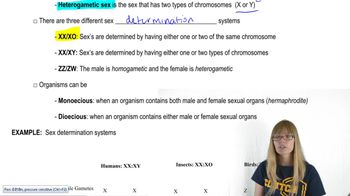
Sex Determination
X-linked Recessive Inheritance
X-linked recessive traits are carried on the X chromosome and usually manifest in males who have only one X chromosome, making them hemizygous. Females must inherit two copies of the recessive allele to express the trait. This inheritance pattern influences the phenotypic ratios observed in offspring, especially when crossing heterozygous females with normal or affected males.
Recommended video:
Guided course
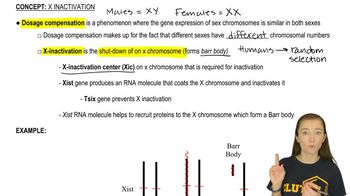
X-Inactivation
Mendelian Crosses and Generational Analysis (F1 and F2)
Mendelian genetics involves analyzing offspring (F1 and F2 generations) from specific parental crosses to predict genotype and phenotype ratios. The F1 generation results from the initial cross, while the F2 generation comes from crossing F1 individuals. Understanding these generations helps contrast expected phenotypic outcomes when considering sex-linked traits and heterogametic sex.
Recommended video:
Guided course
Step 6
Related Videos
Related Practice
Textbook Question
The phenotype of an early-stage human embryo is considered sexually indifferent. Explain why this is so even though the embryo's genotypic sex is already fixed.
1088
views
