A F+ bacterial cell can donate DNA to which type of bacterium?
Table of contents
- 1. Introduction to Genetics51m
- 2. Mendel's Laws of Inheritance3h 37m
- 3. Extensions to Mendelian Inheritance2h 41m
- 4. Genetic Mapping and Linkage2h 28m
- 5. Genetics of Bacteria and Viruses1h 21m
- 6. Chromosomal Variation1h 48m
- 7. DNA and Chromosome Structure56m
- 8. DNA Replication1h 10m
- 9. Mitosis and Meiosis1h 34m
- 10. Transcription1h 0m
- 11. Translation58m
- 12. Gene Regulation in Prokaryotes1h 19m
- 13. Gene Regulation in Eukaryotes44m
- 14. Genetic Control of Development44m
- 15. Genomes and Genomics1h 50m
- 16. Transposable Elements47m
- 17. Mutation, Repair, and Recombination1h 6m
- 18. Molecular Genetic Tools19m
- 19. Cancer Genetics29m
- 20. Quantitative Genetics1h 26m
- 21. Population Genetics50m
- 22. Evolutionary Genetics29m
5. Genetics of Bacteria and Viruses
Bacterial Conjugation
Problem 1c
Textbook Question
For bacteria that are F⁺, Hfr, F', and F⁻ perform or answer the following.
Which of these donors can convert exconjugants to a donor state?
Verified step by step guidance1
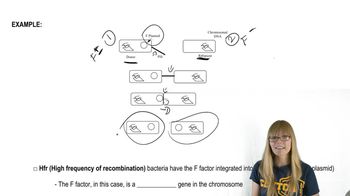
Understand the types of bacterial cells involved: F⁺ cells contain the F plasmid, which allows them to act as donors during conjugation. Hfr cells have the F plasmid integrated into their chromosome, enabling high-frequency recombination. F' cells contain the F plasmid with additional chromosomal genes, and F⁻ cells lack the F plasmid and cannot act as donors.
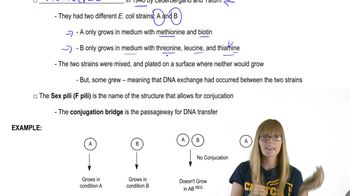
Recall the process of bacterial conjugation: During conjugation, the donor cell transfers genetic material to the recipient cell through a pilus. The ability to convert exconjugants to a donor state depends on whether the F plasmid or its equivalent is transferred.
Analyze the F⁺ cells: F⁺ cells can transfer the F plasmid to F⁻ cells during conjugation, converting them into F⁺ cells, which are capable of acting as donors.
Analyze the Hfr cells: Hfr cells transfer chromosomal genes during conjugation, but they typically do not transfer the entire F plasmid. As a result, exconjugants usually remain F⁻ and cannot act as donors.
Analyze the F' cells: F' cells can transfer the F' plasmid (which includes the F plasmid and additional chromosomal genes) to F⁻ cells during conjugation, converting them into F' cells, which are capable of acting as donors.
Verified video answer for a similar problem:This video solution was recommended by our tutors as helpful for the problem above
Video duration:
3mPlay a video:
Was this helpful?
Key Concepts
Here are the essential concepts you must grasp in order to answer the question correctly.
Conjugation in Bacteria
Conjugation is a process of genetic transfer in bacteria where one bacterium transfers genetic material to another through direct contact. This typically involves a donor cell (F⁺ or Hfr) and a recipient cell (F⁻). The donor's plasmid or chromosomal DNA can be transferred, leading to genetic recombination in the recipient.
Recommended video:
Guided course
Conjugation Overview
F⁺ and F' Strains
F⁺ strains contain a fertility factor (F plasmid) that allows them to initiate conjugation. F' strains are derived from F⁺ strains but carry additional chromosomal genes along with the F plasmid. Both types can convert F⁻ recipients into F⁺ donors through the transfer of the F plasmid during conjugation.
Recommended video:
Guided course
F Factor and Hfr
Hfr Strains
Hfr (High-frequency recombination) strains have the F plasmid integrated into their chromosomal DNA. During conjugation, they can transfer chromosomal genes to a recipient, which may lead to the recipient acquiring donor characteristics. However, Hfr strains typically do not convert recipients to donor states unless the entire F plasmid is transferred, which is rare.
Recommended video:
Guided course
F Factor and Hfr
Related Videos
Related Practice
Multiple Choice
689
views
1
rank