Hershey and Chase selected the bacteriophage T2 for their experiment assessing the role of DNA in heredity because T2 contains protein and DNA, but not RNA. Explain why T2 was a good choice for this experiment.
Table of contents
- 1. Introduction to Genetics51m
- 2. Mendel's Laws of Inheritance3h 37m
- 3. Extensions to Mendelian Inheritance2h 41m
- 4. Genetic Mapping and Linkage2h 28m
- 5. Genetics of Bacteria and Viruses1h 21m
- 6. Chromosomal Variation1h 48m
- 7. DNA and Chromosome Structure56m
- 8. DNA Replication1h 10m
- 9. Mitosis and Meiosis1h 34m
- 10. Transcription1h 0m
- 11. Translation58m
- 12. Gene Regulation in Prokaryotes1h 19m
- 13. Gene Regulation in Eukaryotes44m
- 14. Genetic Control of Development44m
- 15. Genomes and Genomics1h 50m
- 16. Transposable Elements47m
- 17. Mutation, Repair, and Recombination1h 6m
- 18. Molecular Genetic Tools19m
- 19. Cancer Genetics29m
- 20. Quantitative Genetics1h 26m
- 21. Population Genetics50m
- 22. Evolutionary Genetics29m
7. DNA and Chromosome Structure
DNA as the Genetic Material
Problem 5
Textbook Question
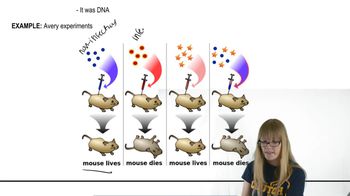
When Avery and his colleagues had obtained what was concluded to be the transforming factor from the IIIS virulent cells, they treated the fraction with proteases, RNase, and DNase, followed in each case by the assay for retention or loss of transforming ability. What were the purpose and results of these experiments? What conclusions were drawn?
Verified step by step guidance1
Step 1: Understand the context of Avery's experiment, which aimed to identify the 'transforming factor' responsible for transferring genetic information from virulent IIIS cells to non-virulent IIR cells, causing transformation.
Step 2: Recognize that Avery and colleagues treated the purified transforming material with three different enzymes: proteases (which degrade proteins), RNase (which degrades RNA), and DNase (which degrades DNA), to determine which type of molecule was responsible for transformation.
Step 3: Analyze the purpose of each treatment: proteases tested if proteins were the transforming factor, RNase tested if RNA was responsible, and DNase tested if DNA was the transforming molecule.
Step 4: Note the results: treatment with proteases and RNase did not abolish the transforming ability, meaning transformation still occurred, whereas treatment with DNase destroyed the transforming ability, indicating that DNA was necessary for transformation.
Step 5: Conclude that the transforming factor was DNA, as only DNase treatment eliminated the ability to transform non-virulent cells, providing strong evidence that DNA carries genetic information.
Verified video answer for a similar problem:This video solution was recommended by our tutors as helpful for the problem above
Video duration:
1mPlay a video:
Was this helpful?
Key Concepts
Here are the essential concepts you must grasp in order to answer the question correctly.
Transforming Principle
The transforming principle refers to the substance responsible for transferring genetic information from one bacterial strain to another, as demonstrated in Griffith's experiment. Avery and colleagues aimed to identify this factor by isolating it from virulent IIIS cells and testing its ability to transform non-virulent bacteria.
Recommended video:
Guided course
Transformation
Enzymatic Treatment to Identify Macromolecules
Proteases, RNase, and DNase are enzymes that degrade proteins, RNA, and DNA respectively. By treating the transforming factor with these enzymes, Avery's team tested which macromolecule was essential for transformation, observing whether the ability to transform bacteria was lost after each treatment.
Recommended video:
Guided course
Cancer Characteristics
DNA as the Genetic Material
The experiments showed that only DNase treatment destroyed the transforming ability, indicating DNA was the transforming factor. This provided strong evidence that DNA, not protein or RNA, carries genetic information, a foundational discovery in molecular genetics.
Recommended video:
Guided course
History and Experiments
Watch next
Master History and Experiments with a bite sized video explanation from Kylia
Start learningRelated Videos
Related Practice
Textbook Question
486
views
