Discuss the reasons proteins were generally favored over DNA as the genetic material before 1940. What was the role of the tetranucleotide hypothesis in this controversy?
Table of contents
- 1. Introduction to Genetics51m
- 2. Mendel's Laws of Inheritance3h 37m
- 3. Extensions to Mendelian Inheritance2h 41m
- 4. Genetic Mapping and Linkage2h 28m
- 5. Genetics of Bacteria and Viruses1h 21m
- 6. Chromosomal Variation1h 48m
- 7. DNA and Chromosome Structure56m
- 8. DNA Replication1h 10m
- 9. Mitosis and Meiosis1h 34m
- 10. Transcription1h 0m
- 11. Translation58m
- 12. Gene Regulation in Prokaryotes1h 19m
- 13. Gene Regulation in Eukaryotes44m
- 14. Genetic Control of Development44m
- 15. Genomes and Genomics1h 50m
- 16. Transposable Elements47m
- 17. Mutation, Repair, and Recombination1h 6m
- 18. Molecular Genetic Tools19m
- 19. Cancer Genetics29m
- 20. Quantitative Genetics1h 26m
- 21. Population Genetics50m
- 22. Evolutionary Genetics29m
7. DNA and Chromosome Structure
DNA as the Genetic Material
Problem 5
Textbook Question
Given the state of knowledge at the time of the Avery, MacLeod, and McCarty experiment, why was it difficult for some scientists to accept that DNA is the carrier of genetic information?
Verified step by step guidance1
Understand the historical context: Before the Avery, MacLeod, and McCarty experiment, proteins were widely believed to be the carriers of genetic information because of their complexity and diversity, whereas DNA was thought to be too simple chemically.
Recognize the chemical composition of DNA: DNA is composed of only four types of nucleotides, which seemed insufficient to encode the vast diversity of genetic traits, leading to skepticism about its role as genetic material.
Consider the experimental evidence available at the time: Many scientists had not yet seen conclusive proof that DNA, rather than protein, was responsible for heredity, and the mechanisms of DNA replication and function were not yet understood.
Acknowledge the prevailing scientific paradigms: The idea that a relatively simple molecule like DNA could carry complex genetic information challenged existing beliefs and required a paradigm shift in molecular biology.
Note that the Avery, MacLeod, and McCarty experiment provided strong evidence by demonstrating that purified DNA from a virulent strain could transform non-virulent bacteria, but acceptance required further confirmation and understanding of DNA's structure and function.
Verified video answer for a similar problem:This video solution was recommended by our tutors as helpful for the problem above
Video duration:
2mPlay a video:
Was this helpful?
Key Concepts
Here are the essential concepts you must grasp in order to answer the question correctly.
Historical Context of Genetic Material
Before the Avery, MacLeod, and McCarty experiment, proteins were widely believed to be the genetic material due to their complexity and diversity. DNA was considered too simple chemically to carry genetic information, making it difficult for scientists to accept DNA as the hereditary molecule.
Recommended video:
Guided course
History and Experiments
Avery, MacLeod, and McCarty Experiment
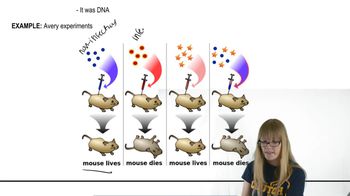
This experiment demonstrated that DNA, not protein, was responsible for transforming non-virulent bacteria into virulent forms. By isolating DNA and showing it could transfer genetic traits, they provided strong evidence that DNA carries genetic information.
Recommended video:
Guided course
Mendel's Experiments
Skepticism and Scientific Paradigms
Scientific acceptance often requires overwhelming evidence and shifts in prevailing paradigms. The idea that DNA was genetic material challenged existing beliefs, and the lack of understanding of DNA’s structure and function at the time contributed to skepticism among scientists.
Recommended video:
Guided course
Discovery of Crossing Over
Watch next
Master History and Experiments with a bite sized video explanation from Kylia
Start learningRelated Videos
Related Practice
Textbook Question
1031
views