DNA is replicated through which method?
Table of contents
- 1. Introduction to Genetics51m
- 2. Mendel's Laws of Inheritance3h 37m
- 3. Extensions to Mendelian Inheritance2h 41m
- 4. Genetic Mapping and Linkage2h 28m
- 5. Genetics of Bacteria and Viruses1h 21m
- 6. Chromosomal Variation1h 48m
- 7. DNA and Chromosome Structure56m
- 8. DNA Replication1h 10m
- 9. Mitosis and Meiosis1h 34m
- 10. Transcription1h 0m
- 11. Translation58m
- 12. Gene Regulation in Prokaryotes1h 19m
- 13. Gene Regulation in Eukaryotes44m
- 14. Genetic Control of Development44m
- 15. Genomes and Genomics1h 50m
- 16. Transposable Elements47m
- 17. Mutation, Repair, and Recombination1h 6m
- 18. Molecular Genetic Tools19m
- 19. Cancer Genetics29m
- 20. Quantitative Genetics1h 26m
- 21. Population Genetics50m
- 22. Evolutionary Genetics29m
8. DNA Replication
Semiconservative Replication
Problem 26
Textbook Question
Assume a hypothetical organism in which DNA replication is conservative. Design an experiment similar to that of Taylor, Woods, and Hughes that will unequivocally establish this fact. Using the format established in Figure 11.5, draw sister chromatids and illustrate the expected results establishing this mode of replication.
Verified step by step guidance1
Recall that in conservative DNA replication, the original double-stranded DNA molecule remains intact, and an entirely new double-stranded DNA molecule is synthesized. This contrasts with semiconservative replication, where each daughter DNA molecule contains one original and one new strand.
Design an experiment similar to Taylor, Woods, and Hughes by using a labeled nucleotide precursor (such as radioactive thymidine or a heavy isotope like 15N) to distinguish newly synthesized DNA from original DNA. Grow cells in the presence of this label for one round of DNA replication.
After one replication cycle, transfer the cells to a medium without the label and allow them to replicate again. Then, prepare chromosome spreads and use autoradiography to detect the location of the label on sister chromatids.
Draw sister chromatids as pairs of double-stranded DNA molecules. For conservative replication, after one round, one chromatid should be fully labeled (new DNA) and the other fully unlabeled (original DNA). After the second round, you would expect one chromatid fully labeled and the other fully unlabeled in each pair, with no mixing of label within chromatids.
Compare this expected pattern to the semiconservative model (where each chromatid would be half-labeled after one round) to unequivocally establish conservative replication. The key is that in conservative replication, the label is segregated into entirely new DNA molecules, not distributed between strands.
Verified video answer for a similar problem:This video solution was recommended by our tutors as helpful for the problem above
Video duration:
2mPlay a video:
Was this helpful?
Key Concepts
Here are the essential concepts you must grasp in order to answer the question correctly.
DNA Replication Models
DNA replication can occur via three models: conservative, semi-conservative, and dispersive. In conservative replication, the original DNA molecule remains intact, and an entirely new copy is made. Understanding these models is essential to design experiments that distinguish between them based on the distribution of labeled DNA strands after replication.
Recommended video:
Guided course
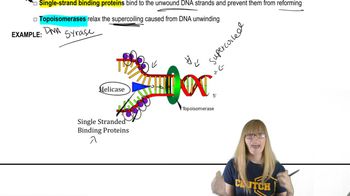
Steps to DNA Replication
Taylor, Woods, and Hughes Experiment
This classic experiment used radioactive thymidine to label DNA in root tip cells and autoradiography to track replication. It demonstrated semi-conservative replication by showing one labeled and one unlabeled chromatid after one replication cycle. Knowing this method helps in designing similar experiments to test alternative replication models.
Recommended video:
Guided course
Mendel's Experiments
Autoradiography and Chromatid Visualization
Autoradiography detects radioactive labels incorporated into DNA, allowing visualization of newly synthesized strands. Drawing sister chromatids with expected label patterns after replication cycles helps interpret results. For conservative replication, one chromatid would be fully labeled and the other unlabeled, a key visual distinction.
Recommended video:
Guided course
Chromatin
Watch next
Master Semiconservative Replication with a bite sized video explanation from Kylia
Start learningRelated Videos
Related Practice
Multiple Choice
865
views
3
rank
