
Table of contents
- 1. Introduction to Genetics51m
- 2. Mendel's Laws of Inheritance3h 37m
- 3. Extensions to Mendelian Inheritance2h 41m
- 4. Genetic Mapping and Linkage2h 28m
- 5. Genetics of Bacteria and Viruses1h 21m
- 6. Chromosomal Variation1h 48m
- 7. DNA and Chromosome Structure56m
- 8. DNA Replication1h 10m
- 9. Mitosis and Meiosis1h 34m
- 10. Transcription1h 0m
- 11. Translation58m
- 12. Gene Regulation in Prokaryotes1h 19m
- 13. Gene Regulation in Eukaryotes44m
- 14. Genetic Control of Development44m
- 15. Genomes and Genomics1h 50m
- 16. Transposable Elements47m
- 17. Mutation, Repair, and Recombination1h 6m
- 18. Molecular Genetic Tools19m
- 19. Cancer Genetics29m
- 20. Quantitative Genetics1h 26m
- 21. Population Genetics50m
- 22. Evolutionary Genetics29m
8. DNA Replication
Semiconservative Replication
Problem 20
Textbook Question
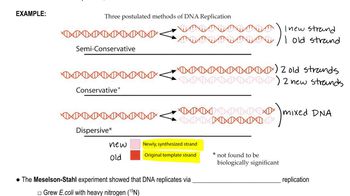
Matthew Meselson and Franklin Stahl demonstrated that DNA replication is semiconservative in bacteria. Briefly outline their experiment and its results for two DNA replication cycles, and identify how the alternative models of DNA replication were excluded by the data.
Verified step by step guidance1
Meselson and Stahl grew *Escherichia coli* in a medium containing heavy nitrogen isotope (¹⁵N) so that the DNA incorporated the heavier isotope, making it denser. This was the starting point for their experiment.
The bacteria were then transferred to a medium containing the lighter nitrogen isotope (¹⁴N) and allowed to replicate. After one replication cycle, DNA was extracted and analyzed using density gradient centrifugation to separate DNA based on its density.
After the first replication cycle, the DNA formed a single intermediate-density band, which was consistent with the semiconservative model (one strand ¹⁵N and one strand ¹⁴N) and excluded the conservative model (which would predict one heavy band and one light band).
The bacteria were allowed to replicate for a second cycle in the ¹⁴N medium. After this cycle, the DNA formed two distinct bands: one of intermediate density and one of light density. This result further supported the semiconservative model and excluded the dispersive model (which would predict a single band of intermediate density that becomes lighter over time).
The semiconservative model was confirmed because the data showed that each new DNA molecule consisted of one original (¹⁵N-labeled) strand and one newly synthesized (¹⁴N-labeled) strand after the first cycle, and subsequent cycles produced more DNA with only ¹⁴N strands.
Verified video answer for a similar problem:This video solution was recommended by our tutors as helpful for the problem above
Video duration:
2mPlay a video:
Was this helpful?
Key Concepts
Here are the essential concepts you must grasp in order to answer the question correctly.
Semiconservative Replication
Semiconservative replication is the process by which DNA makes copies of itself, where each new DNA molecule consists of one original strand and one newly synthesized strand. This model was proposed to explain how genetic information is accurately passed on during cell division, ensuring that each daughter cell receives an exact copy of the DNA.
Recommended video:
Guided course
Semiconservative Replication
Meselson-Stahl Experiment
The Meselson-Stahl experiment utilized isotopes of nitrogen to label DNA in bacteria. By growing E. coli in a medium containing heavy nitrogen (N-15) and then transferring them to a medium with light nitrogen (N-14), they analyzed the density of the DNA after one and two replication cycles. The results showed that after one cycle, the DNA had an intermediate density, and after two cycles, there were both light and intermediate density DNA, supporting the semiconservative model.
Recommended video:
Guided course
Mendel's Experiments
Exclusion of Alternative Models
The alternative models of DNA replication included conservative and dispersive replication. The conservative model suggested that the original DNA strands remained together, while the dispersive model proposed that parental and new DNA would be interspersed. The results of the Meselson-Stahl experiment, showing distinct bands of DNA density, effectively excluded these models, as they could not account for the observed intermediate density after one replication cycle.
Recommended video:
Guided course
Alternative DNA Forms
Watch next
Master Semiconservative Replication with a bite sized video explanation from Kylia
Start learningRelated Videos
Related Practice
Multiple Choice
The term semiconservative refers specifically to which aspect of DNA replication?
23
views
