How do geneticists detect the presence of genetic variation as different alleles in a population?
Verified step by step guidance
1
Understand that genetic variation refers to differences in DNA sequences among individuals in a population, often manifested as different alleles of a gene.
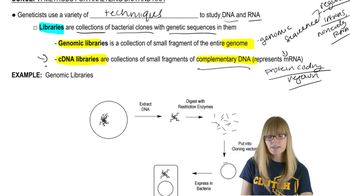
Recognize that geneticists detect these variations by analyzing specific regions of DNA using molecular techniques such as PCR (Polymerase Chain Reaction) to amplify the target gene segments.
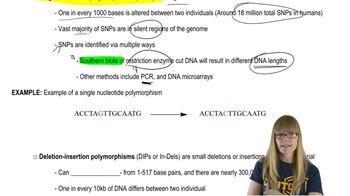
Use methods like gel electrophoresis to separate DNA fragments based on size, which can reveal different alleles if they produce fragments of varying lengths (e.g., in restriction fragment length polymorphism analysis).
Apply DNA sequencing to directly read the nucleotide sequence of the gene region, allowing identification of single nucleotide polymorphisms (SNPs) or other mutations that represent different alleles.
Utilize population genetics tools and statistical analyses to compare allele frequencies across individuals, confirming the presence and distribution of genetic variation within the population.
Verified video answer for a similar problem:
This video solution was recommended by our tutors as helpful for the problem above
Video duration:
1m
Play a video:
Was this helpful?
Key Concepts
Here are the essential concepts you must grasp in order to answer the question correctly.
Genetic Variation
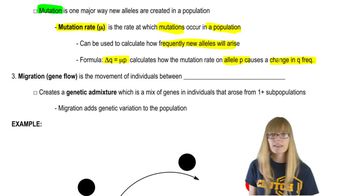
Genetic variation refers to differences in DNA sequences among individuals within a population. These variations can manifest as different alleles of a gene, which contribute to diversity in traits and can affect an organism's fitness and evolution.
Alleles are alternative forms of a gene found at the same locus on homologous chromosomes. Geneticists detect different alleles using molecular techniques such as DNA sequencing, PCR, or gel electrophoresis, which reveal variations in nucleotide sequences or fragment sizes.
Population genetics involves studying allele frequencies and distributions within populations. Tools like genotyping, marker analysis, and statistical models help geneticists assess genetic variation, track inheritance patterns, and understand evolutionary processes.