Which of the following answer options describes an instance where protein turnover is a useful process?
Table of contents
- 1. Science of Nutrition1h 52m
- 2. Tools for Healthful Eating1h 51m
- 3. The Human Body & Digestion2h 7m
- 4. Carbohydrates3h 11m
- 5. Lipids2h 31m
- 6. Proteins2h 16m
- 7. Vitamins2h 20m
- 8. Water and Minerals2h 55m
- Water45m
- Introduction to Minerals9m
- Major Mineral: Sodium and Potassium18m
- Hypertension and Minerals12m
- Major Mineral: Calcium and Phosphorus21m
- Osteoporosis: Minerals and Bone Health14m
- Major Mineral: Chloride, Magnesium, & Sulfur16m
- Trace minerals: Iron and Copper14m
- Trace minerals: Fluoride and Iodine9m
- Other Trace Minerals13m
- 9. Alcohol57m
- 10. Energy Balance: Body Weight, Obesity, & Eating Disorders3h 7m
- 11. Nutrition & Fitness1h 7m
- 12. Food Safety & Regulation2h 3m
- 13. Food Insecurity in the US and the World37m
- 15. Nutrition: Toddlers to Late Adulthood42m
6. Proteins
Protein Digestion
Struggling with Nutrition?
Join thousands of students who trust us to help them ace their exams!Watch the first videoMultiple Choice
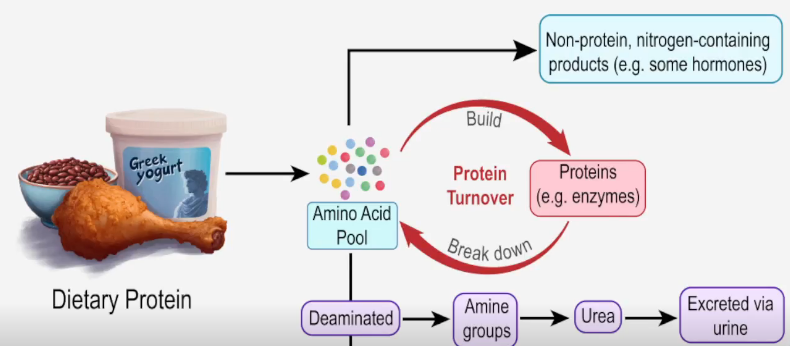
Based on the diagram below, which of the following statements is correct?

A
Once amino acids are absorbed, they are first built up into proteins, then relocated throughout the body.
B
Amino acids are absorbed by the small intestine, then deaminated before entering the amino acid pool.
C
All protein that is deaminated will be excreted in urine.
D
While most of the amino acids absorbed by the body are used to make protein some are used to make non-protein products such as glucose, fat, & some nitrogen-containing molecules.
Verified step by step guidance1
Examine the diagram provided. It illustrates the process of protein metabolism, starting with dietary protein being broken down into amino acids, which enter the amino acid pool.
Understand the role of the amino acid pool. Amino acids in this pool can be used for protein turnover, where they are either built into proteins (e.g., enzymes) or broken down again.
Note that some amino acids are used to create non-protein, nitrogen-containing products, such as hormones, as indicated in the diagram.
Observe the deamination process. Amino acids that are not used for protein synthesis or non-protein products undergo deamination, where the amine group is removed.
Follow the pathway after deamination. The amine groups are converted into urea, which is then excreted via urine, as shown in the diagram.
Watch next
Master Protein Digestion with a bite sized video explanation from Bruce Bryan
Start learningRelated Videos
Related Practice
Multiple Choice
Protein Digestion practice set