
Ch 09: Rotation of Rigid Bodies
Young & Freedman Calc - University Physics 14th Edition
Young & Freedman Calc14th EditionUniversity PhysicsISBN: 9780321973610Not the one you use?Change textbook
Chapter 9, Problem 24ab

An electric turntable 0.750 m in diameter is rotating about a fixed axis with an initial angular velocity of 0.250 rev/s and a constant angular acceleration of 0.900 rev/s2.
(a) Compute the angular velocity of the turntable after 0.200 s.
(b) Through how many revolutions has the turntable spun in this time interval?

Verified step by step guidance
1
Step 1: Identify the given values for part (a). The initial angular velocity \( \omega_0 \) is 0.250 rev/s, the angular acceleration \( \alpha \) is 0.900 rev/s², and the time \( t \) is 0.200 s. Use the kinematic equation for angular velocity: \( \omega = \omega_0 + \alpha t \).
Step 2: Substitute the given values into the equation \( \omega = \omega_0 + \alpha t \). This will give the angular velocity \( \omega \) after 0.200 s. Ensure the units are consistent (revolutions per second).
Step 3: For part (b), use the kinematic equation for angular displacement: \( \theta = \omega_0 t + \frac{1}{2} \alpha t^2 \), where \( \theta \) is the angular displacement in revolutions. Substitute the given values for \( \omega_0 \), \( \alpha \), and \( t \).
Step 4: Calculate \( \theta \) by performing the arithmetic operations in the equation \( \theta = \omega_0 t + \frac{1}{2} \alpha t^2 \). This will give the total angular displacement in revolutions during the 0.200 s interval.
Step 5: Interpret the results. The angular velocity \( \omega \) from part (a) represents how fast the turntable is spinning at the end of the time interval, while the angular displacement \( \theta \) from part (b) represents the total number of revolutions the turntable has completed during the interval.

Verified video answer for a similar problem:

This video solution was recommended by our tutors as helpful for the problem above.
Video duration:
2m
Was this helpful?

Key Concepts

Here are the essential concepts you must grasp in order to answer the question correctly.

Angular Velocity

Angular velocity is a measure of how quickly an object rotates around an axis, typically expressed in radians per second or revolutions per second. It indicates the rate of change of angular displacement and is crucial for understanding rotational motion. In this problem, the initial angular velocity is given, and we need to calculate the final angular velocity after a certain time interval.
Recommended video:
Guided course
06:18
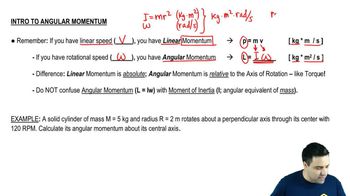
Intro to Angular Momentum

Angular Acceleration

Angular acceleration refers to the rate of change of angular velocity over time, measured in revolutions per second squared or radians per second squared. It indicates how quickly an object is speeding up or slowing down in its rotation. In this scenario, the constant angular acceleration allows us to determine the change in angular velocity over the specified time period.
Recommended video:
Guided course
12:12
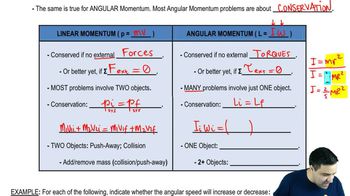
Conservation of Angular Momentum

Rotational Kinematics

Rotational kinematics involves the equations that describe the motion of rotating objects, analogous to linear kinematics for straight-line motion. Key equations relate angular displacement, angular velocity, and angular acceleration. In this question, we will use these equations to calculate both the final angular velocity and the total number of revolutions made by the turntable during the time interval.
Recommended video:
Guided course
08:25
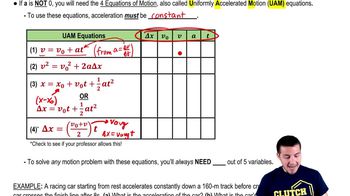
Kinematics Equations
Related Practice
Textbook Question

Four small spheres, each of which you can regard as a point of mass 0.200 kg, are arranged in a square 0.400 m on a side and connected by extremely light rods (Fig. E9.28). Find the moment of inertia of the system about an axis that passes through the centers of the upper left and lower right spheres and through point O.

2556
views
Textbook Question

A wheel of diameter 40.0 cm starts from rest and rotates with a constant angular acceleration of 3.00 rad/s2. Compute the radial acceleration of a point on the rim for the instant the wheel completes its second revolution from the relationship arad = v2/r.

2055
views
Textbook Question

A compact disc (CD) stores music in a coded pattern of tiny pits 10-7 m deep. The pits are arranged in a track that spirals outward toward the rim of the disc; the inner and outer radii of this spiral are 25.0 mm and 58.0 mm, respectively. As the disc spins inside a CD player, the track is scanned at a constant linear speed of 1.25 m/s. What is the average angular acceleration of a maximum duration CD during its 74.0-min playing time? Take the direction of rotation of the disc to be positive.

1739
views
Textbook Question

A wheel of diameter 40.0 cm starts from rest and rotates with a constant angular acceleration of 3.00 rad/s2. Compute the radial acceleration of a point on the rim for the instant the wheel completes its second revolution from the relationship arad = ω2r.

2019
views
Textbook Question

An electric turntable 0.750 m in diameter is rotating about a fixed axis with an initial angular velocity of 0.250 rev/s and a constant angular acceleration of 0.900 rev/s2. What is the tangential speed of a point on the rim of the turntable at t = 0.200 s?

3157
views
1
comments
Textbook Question

An electric turntable 0.750 m in diameter is rotating about a fixed axis with an initial angular velocity of 0.250 rev/s and a constant angular acceleration of 0.900 rev/s2. What is the magnitude of the resultant acceleration of a point on the rim at t = 0.200 s?

126
views