
In 2014, the European Space Agency placed a satellite in orbit around comet 67P/Churyumov-Gerasimenko and then landed a probe on the surface. The actual orbit was elliptical, but we’ll approximate it as a 50-km-diameter circular orbit with a period of 11 days. What is the mass of the comet?
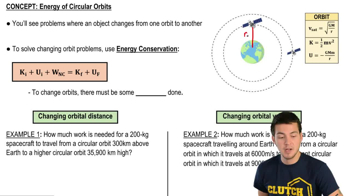
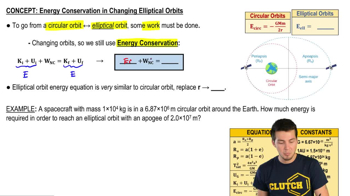
The 75,000 kg space shuttle used to fly in a 250-km-high circular orbit. It needed to reach a 610-km-high circular orbit to service the Hubble Space Telescope. How much energy was required to boost it to the new orbit?
Verified step by step guidance
Verified video answer for a similar problem:
Key Concepts
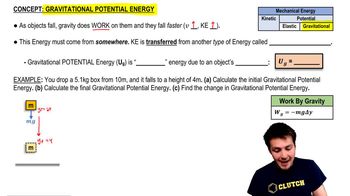
Gravitational Potential Energy
Kinetic Energy in Orbital Motion
Energy Conservation in Orbital Mechanics
A 4000 kg lunar lander is in orbit 50 km above the surface of the moon. It needs to move out to a 300-km-high orbit in order to link up with the mother ship that will take the astronauts home. How much work must the thrusters do?
FIGURE P13.57 shows two planets of mass m orbiting a star of mass M. The planets are in the same orbit, with radius r, but are always at opposite ends of a diameter. Find an exact expression for the orbital period T. Hint: Each planet feels two forces.
A starship is circling a distant planet of radius R. The astronauts find that the free-fall acceleration at their altitude is half the value at the planet's surface. How far above the surface are they orbiting? Your answer will be a multiple of R.
In 2000, NASA placed a satellite in orbit around an asteroid. Consider a spherical asteroid with a mass of 1.0 x 10¹⁶ kg and a radius of 8.8 km. What is the escape speed from the asteroid?
The two stars in a binary star system have masses 2.0 x 10³⁰ kg and 6.0 x 10³⁰ kg. They are separated by 2.0 x 10¹² m. What are The speed of each star?
