An element in its solid phase has mass density 1750 kg/m3 and number density 4.39×1028 atoms/m3. What is the element's atomic mass number?
Verified step by step guidance
1
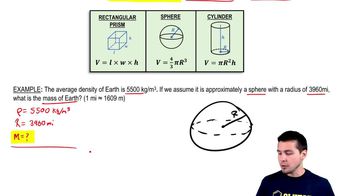
Step 1: Understand the relationship between mass density, number density, and atomic mass. The mass density (ρ) of a material is related to its number density (n) and atomic mass (mₐ) by the equation: ρ = n × mₐ.
Step 2: Rearrange the formula to solve for the atomic mass (mₐ). Using the equation ρ = n × mₐ, isolate mₐ: mₐ = ρ / n.
Step 3: Substitute the given values into the formula. The mass density (ρ) is 1750 kg/m³, and the number density (n) is 4.39 × 10^28 atoms/m³. Ensure the units are consistent.
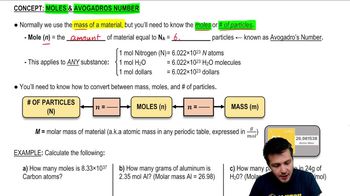
Step 4: Convert the atomic mass from kilograms to atomic mass units (u). Recall that 1 atomic mass unit (u) is equal to 1.660539 × 10^-27 kg. Use the conversion factor: mₐ (in u) = mₐ (in kg) / (1.660539 × 10^-27).
Step 5: Interpret the result. The atomic mass number is approximately the atomic mass in atomic mass units (u), rounded to the nearest whole number, as it represents the number of protons and neutrons in the nucleus of the element.
Verified video answer for a similar problem:
This video solution was recommended by our tutors as helpful for the problem above
Video duration:
4m
Play a video:
Was this helpful?
Key Concepts
Here are the essential concepts you must grasp in order to answer the question correctly.
Mass Density
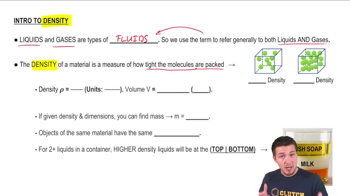
Mass density is defined as the mass of a substance per unit volume, typically expressed in kilograms per cubic meter (kg/m³). It provides insight into how compact the matter is within a given volume. In this question, the mass density of the solid phase of the element is given as 1750 kg/m³, which is crucial for calculating the atomic mass number.
Number density refers to the number of particles (atoms, molecules, etc.) per unit volume, usually expressed in particles per cubic meter (m⁻³). In this case, the number density of the element is provided as 4.39×10²⁸ atoms/m³. This concept is essential for relating the mass density to the atomic mass number, as it helps determine how many atoms are present in a specific volume.
The atomic mass number (A) is the total number of protons and neutrons in an atom's nucleus, which determines the mass of the atom. It is a key factor in calculating the mass of a mole of atoms and is related to both mass density and number density. By using the provided mass density and number density, one can derive the atomic mass number through the relationship between these quantities.