
Ch 17: Temperature and Heat
Young & Freedman Calc - University Physics 14th Edition
Young & Freedman Calc14th EditionUniversity PhysicsISBN: 9780321973610Not the one you use?Change textbook
Chapter 17, Problem 42a

Before going in for his annual physical, a 70.0 kg man whose body temperature is 37.0°C consumes an entire 0.355-L can of a soft drink (mostly water) at 12.0°C. What will his body temperature be after equilibrium is attained? Ignore any heating by the man’s metabolism. The specific heat of the man’s body is 3480 J/kg K.

Verified step by step guidance
1
Identify the principle of conservation of energy, which states that the heat lost by the man's body will be equal to the heat gained by the soft drink until thermal equilibrium is reached.
Use the formula for heat transfer: \( Q = mc\Delta T \), where \( Q \) is the heat transferred, \( m \) is the mass, \( c \) is the specific heat capacity, and \( \Delta T \) is the change in temperature.
Calculate the mass of the soft drink. Since the density of water is approximately 1 kg/L, the mass of the 0.355-L soft drink is 0.355 kg.
Set up the equation for heat transfer: \( m_{\text{man}}c_{\text{man}}(T_f - T_{\text{man}}) = -m_{\text{drink}}c_{\text{drink}}(T_f - T_{\text{drink}}) \), where \( T_f \) is the final equilibrium temperature, \( T_{\text{man}} \) is the initial temperature of the man, and \( T_{\text{drink}} \) is the initial temperature of the drink.
Solve the equation for \( T_f \), the final equilibrium temperature, by substituting the known values: \( m_{\text{man}} = 70.0 \) kg, \( c_{\text{man}} = 3480 \) J/kg K, \( T_{\text{man}} = 37.0 \)°C, \( m_{\text{drink}} = 0.355 \) kg, \( c_{\text{drink}} = 4186 \) J/kg K (specific heat of water), and \( T_{\text{drink}} = 12.0 \)°C.

Verified video answer for a similar problem:

This video solution was recommended by our tutors as helpful for the problem above.
Video duration:
8m
Was this helpful?

Key Concepts

Here are the essential concepts you must grasp in order to answer the question correctly.

Specific Heat Capacity

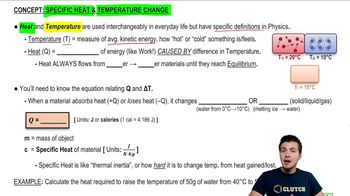
Specific heat capacity is the amount of heat required to change the temperature of a unit mass of a substance by one degree Celsius (or Kelvin). It is a property that indicates how much energy a material can store. In this problem, the specific heat of the man's body is given as 3480 J/kg K, which is crucial for calculating the heat exchange between the man's body and the soft drink.
Recommended video:
Guided course
06:50
Specific Heat & Temperature Changes

Heat Transfer and Thermal Equilibrium

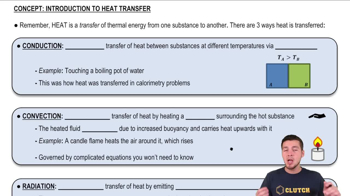
Heat transfer is the process of energy moving from a warmer object to a cooler one until thermal equilibrium is reached, meaning both objects attain the same temperature. In this scenario, the man's body and the soft drink will exchange heat until they reach a common temperature. Understanding this concept helps in setting up the equation to find the final equilibrium temperature.
Recommended video:
Guided course
05:14
Overview of Heat Transfer

Conservation of Energy

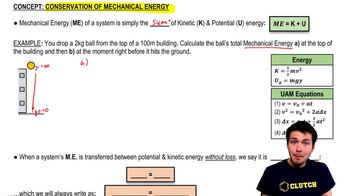
The principle of conservation of energy states that energy cannot be created or destroyed, only transferred or converted from one form to another. In the context of this problem, the heat lost by the man's body will equal the heat gained by the soft drink, assuming no other heat exchanges occur. This principle is used to set up the equation that allows us to solve for the final body temperature.
Recommended video:
Guided course
06:24
Conservation Of Mechanical Energy
Related Practice
Textbook Question

A copper calorimeter can with mass 0.100 kg contains 0.160 kg of water and 0.0180 kg of ice in thermal equilibrium at atmospheric pressure. If 0.750 kg of lead at 255°C is dropped into the calorimeter can, what is the final temperature? Assume that no heat is lost to the surroundings.

1953
views
Textbook Question

A laboratory technician drops a 0.08500.0850-kg sample of unknown solid material, at 100.0100.0°C, into a calorimeter. The calorimeter can, initially at 19.019.0°C, is made of 0.1500.150 kg of copper and contains 0.2000.200 kg of water. The final temperature of the calorimeter can and contents is 26.126.1°C. Compute the specific heat of the sample.

1489
views
Textbook Question

An asteroid with a diameter of 10 km and a mass of 2.60 × 10¹⁵ kg impacts the earth at a speed of 32.0 km/s, landing in the Pacific Ocean. If 1.00% of the asteroid's kinetic energy goes to boiling the ocean water (assume an initial water temperature of 10.0°C), what mass of water will be boiled away by the collision? (For comparison, the mass of water contained in Lake Superior is about 2 × 10¹⁵ kg.)

1587
views
Textbook Question

A copper pot with a mass of 0.500 kg contains 0.170 kg of water, and both are at 20.0°C. A 0.250-kg block of iron at 85.0°C is dropped into the pot. Find the final temperature of the system, assuming no heat loss to the surroundings.

2283
views
Textbook Question

A blacksmith cools a 1.20 kg chunk of iron, initially at 650.0°C, by trickling 15.0°C water over it. All of the water boils away, and the iron ends up at 120.0°C. How much water did the blacksmith trickle over the iron?

2148
views
Textbook Question

An ice-cube tray of negligible mass contains 0.290 kg of water at 18.0°C. How much heat must be removed to cool the water to 0.00°C and freeze it? Express your answer in joules, calories, and Btu.

1455
views