

Reported and Measured Heights Listed below are self-reported heights of males aged 16 and over and their corresponding measured heights (based on data from the National Health and Nutrition Examination Survey). All heights are in inches. First find the differences (reported height–measured height), and then use those differences to find the (h) Q1, (i) Q3
Ch. 3 - Describing, Exploring, and Comparing Data
Chapter 3, Problem 3.r.8
Estimating Standard Deviation Listed below are sorted weights (g) of a sample of M&M plain candies randomly selected from one bag. Use the range rule of thumb to estimate the value of the standard deviation of all 345 M&Ms in the bag. Compare the result to the standard deviation of 0.0366 g computed from all of the 345 M&Ms in the bag.

Verified step by step guidance1
Step 1: Identify the range of the data by subtracting the smallest value from the largest value. From the image, the smallest weight is 0.799 g and the largest weight is 0.944 g. Compute the range as Range = Largest value - Smallest value.
Step 2: Use the range rule of thumb to estimate the standard deviation. The rule states that the standard deviation can be approximated as Standard Deviation ≈ Range / 4.
Step 3: Compare the estimated standard deviation obtained using the range rule of thumb to the given standard deviation of 0.0366 g. Discuss whether the approximation is close to the actual value.
Step 4: Reflect on the limitations of the range rule of thumb. Note that it is a rough estimate and may not always align closely with the actual standard deviation, especially for data sets with non-uniform distributions.
Step 5: Conclude by emphasizing the importance of using more precise methods, such as calculating the standard deviation directly using the formula for standard deviation, for more accurate results.

Verified video answer for a similar problem:
This video solution was recommended by our tutors as helpful for the problem above.
Video duration:
2mWas this helpful?
Key Concepts
Here are the essential concepts you must grasp in order to answer the question correctly.
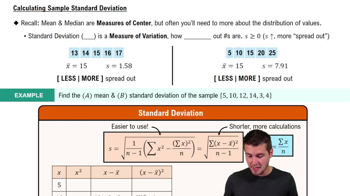
Standard Deviation
Standard deviation is a measure of the amount of variation or dispersion in a set of values. A low standard deviation indicates that the values tend to be close to the mean, while a high standard deviation indicates that the values are spread out over a wider range. It is calculated as the square root of the variance, which is the average of the squared differences from the mean.
Recommended video:
Guided course
Calculating Standard Deviation
Range Rule of Thumb
The range rule of thumb is a simple method for estimating the standard deviation of a dataset. It states that the standard deviation can be approximated as one-fourth of the range of the data, where the range is the difference between the maximum and minimum values. This rule provides a quick way to gauge variability without performing detailed calculations.
Recommended video:
Probability of Mutually Exclusive Events
Comparative Analysis
Comparative analysis involves evaluating two or more sets of data to identify similarities, differences, or trends. In this context, it refers to comparing the estimated standard deviation obtained using the range rule of thumb with the actual standard deviation calculated from the complete dataset of M&Ms. This comparison helps assess the accuracy of the estimation method and understand the data's variability.
Recommended video:
Guided course
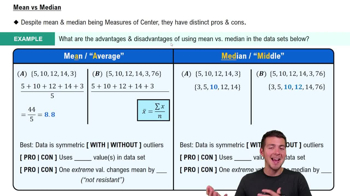
Comparing Mean vs. Median
Related Practice
Textbook Question
138
views
Textbook Question
Reported and Measured Heights Listed below are self-reported heights of males aged 16 and over and their corresponding measured heights (based on data from the National Health and Nutrition Examination Survey). All heights are in inches. First find the differences (reported height–measured height), and then use those differences to find the (a) mean, (b) median, (c) mode,
129
views
Textbook Question
Outliers Identify any of the differences found from Exercise 1 that appear to be outliers. For any outliers, how much of an effect do they have on the mean, median, and standard deviation?
208
views
