
Ch. 3 - Describing, Exploring, and Comparing Data
Triola - Elementary Statistics 14th Edition
Triola14th EditionElementary StatisticsISBN: 9780137366446Not the one you use?Change textbook
Chapter 3, Problem 3.2.45c

Why Divide by ? Let a population consist of the values 9 cigarettes, 10 cigarettes, and 20 cigarettes smoked in a day (based on data from the California Health Interview Survey). Assume that samples of two values are randomly selected with replacement from this population. (That is, a selected value is replaced before the second selection is made.)


c. For each of the nine different possible samples of two values selected with replacement, find the variance by treating each sample as if it is a population (using the formula for population variance, which includes division by n); then find the mean of those nine population variances.

Verified step by step guidance
1
Step 1: Identify the population values and calculate the population mean. The population consists of the values 9, 10, and 20 cigarettes. The population mean (μ) is calculated as the sum of all population values divided by the number of values in the population. Use the formula: μ = (Σx) / N, where Σx is the sum of the population values and N is the number of values in the population.
Step 2: List all possible samples of size 2 with replacement. Since the population has 3 values (9, 10, 20), and sampling is done with replacement, there are 3 × 3 = 9 possible samples. These samples are: (9, 9), (9, 10), (9, 20), (10, 9), (10, 10), (10, 20), (20, 9), (20, 10), (20, 20).
Step 3: For each sample, calculate the sample mean. For a sample (x₁, x₂), the sample mean (x̄) is calculated as: x̄ = (x₁ + x₂) / 2. Perform this calculation for all 9 samples.
Step 4: For each sample, calculate the population variance using the formula for population variance: σ² = (Σ(xᵢ - x̄)²) / n, where xᵢ are the sample values, x̄ is the sample mean, and n is the sample size (n = 2 in this case). Perform this calculation for all 9 samples.
Step 5: Find the mean of the 9 population variances. Add up all 9 variances calculated in Step 4 and divide by 9 to find the mean variance. This mean variance represents the average of the variances when treating each sample as a population.

Verified video answer for a similar problem:

This video solution was recommended by our tutors as helpful for the problem above.
Video duration:
7m
Was this helpful?

Key Concepts

Here are the essential concepts you must grasp in order to answer the question correctly.

Population Variance

Population variance is a measure of how much the values in a population differ from the population mean. It is calculated using the formula: σ² = Σ(xi - μ)² / N, where xi represents each value, μ is the population mean, and N is the total number of values. This concept is crucial for understanding how to quantify the spread of data points in a population.
Recommended video:
04:48
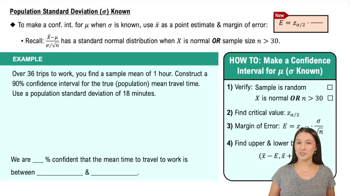
Population Standard Deviation Known

Sampling with Replacement

Sampling with replacement means that after a value is selected from a population, it is returned to the population before the next selection. This method allows for the same value to be chosen multiple times, which affects the calculation of statistics like variance and mean. Understanding this concept is essential for correctly analyzing the samples drawn from the population.
Recommended video:
05:11
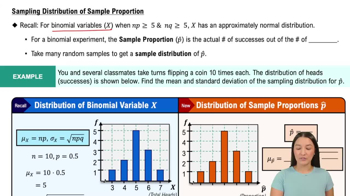
Sampling Distribution of Sample Proportion

Mean of Variances

The mean of variances involves calculating the average of multiple variance values obtained from different samples. In this context, after calculating the population variance for each of the nine possible samples, the mean of these variances provides insight into the overall variability of the samples. This concept helps in understanding the consistency of variance across different sample selections.
Recommended video:
Guided course
08:24
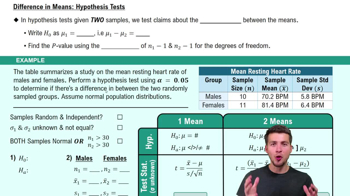
Difference in Means: Hypothesis Tests
Related Practice
Textbook Question

z Scores. In Exercises 5–8, express all z scores with two decimal places.


Diastolic Blood Pressure of Females For the diastolic blood pressure measurements of females listed in Data Set 1 “Body Data” in Appendix B, the highest measurement is 98 mm Hg. The 147 diastolic blood pressure measurements of females have a mean of 70.2 mm Hg and a standard deviation of 11.2 mm Hg.


c. Convert the highest diastolic blood pressure to a z score.

140
views
Textbook Question

z Scores. In Exercises 5–8, express all z scores with two decimal places.


New York City Commute Time New York City commute times (minutes) are listed in Data Set 31 “Commute Times” in Appendix B. The 1000 times have a mean of 42.6 minutes and a standard deviation of 26.2 minutes. Consider the commute time of 95.0 minutes.


d. Using the criteria summarized in Figure 3-6, is the commute time of 95 minutes significantly low, significantly high, or neither?

160
views
Textbook Question

z Scores. In Exercises 5–8, express all z scores with two decimal places.


New York City Commute Time New York City commute times (minutes) are listed in Data Set 31 “Commute Times” in Appendix B. The 1000 times have a mean of 42.6 minutes and a standard deviation of 26.2 minutes. Consider the commute time of 95.0 minutes.


c. Convert the commute time of 95.0 minutes to a z score.

127
views
Textbook Question

Why Divide by ? Let a population consist of the values 9 cigarettes, 10 cigarettes, and 20 cigarettes smoked in a day (based on data from the California Health Interview Survey). Assume that samples of two values are randomly selected with replacement from this population. (That is, a selected value is replaced before the second selection is made.)


d. Which approach results in values that are better estimates of part (b) or part (c)? Why? When computing variances of samples, should you use division by n or

158
views
Textbook Question

Percentile Use the weights from Exercise 1 to find the percentile for 3647 mg.

169
views
Textbook Question

Why Divide by ? Let a population consist of the values 9 cigarettes, 10 cigarettes, and 20 cigarettes smoked in a day (based on data from the California Health Interview Survey). Assume that samples of two values are randomly selected with replacement from this population. (That is, a selected value is replaced before the second selection is made.)

b. After listing the nine different possible samples of two values selected with replacement, find the sample variance (which includes division by ) for each of them; then find the mean of the nine sample variances s2.

155
views