
Ch. 5 - Normal Probability Distributions
Larson - Elementary Statistics: Picturing the World 8th Edition
Larson8th EditionElementary Statistics: Picturing the WorldISBN: 9780137493470Not the one you use?Change textbook
Chapter 5, Problem 5.3.42b

History Grades In a history class, the grades for various assessments are all positive numbers and have different distributions. Determine whether the grades for each assessment could be normally distributed. Explain your reasoning.


b. a final with a mean of 72, standard deviation of 9, and 90th percentile score of 93

Verified step by step guidance
1
Step 1: Understand the characteristics of a normal distribution. A normal distribution is symmetric, bell-shaped, and defined by its mean (μ) and standard deviation (σ). It also follows the empirical rule, where approximately 68% of the data lies within 1σ of the mean, 95% within 2σ, and 99.7% within 3σ.
Step 2: Use the given information to verify if the data aligns with a normal distribution. The problem provides a mean (μ) of 72, a standard deviation (σ) of 9, and a 90th percentile score of 93. In a normal distribution, the 90th percentile corresponds to a z-score of approximately 1.28.
Step 3: Calculate the theoretical value of the 90th percentile using the z-score formula: z = (X - μ) / σ. Rearrange the formula to solve for X (the score): X = μ + z * σ. Substitute the given values: μ = 72, σ = 9, and z = 1.28.
Step 4: Compare the calculated 90th percentile score to the given value of 93. If the calculated value closely matches 93, it supports the assumption that the data could be normally distributed. If there is a significant discrepancy, it may indicate that the data is not normally distributed.
Step 5: Consider other factors that could affect normality, such as the shape of the data distribution, outliers, or skewness. While the calculations provide a numerical check, visualizing the data (e.g., using a histogram or Q-Q plot) would offer additional evidence to confirm or refute normality.

Verified video answer for a similar problem:

This video solution was recommended by our tutors as helpful for the problem above.
Video duration:
3m
Was this helpful?

Key Concepts

Here are the essential concepts you must grasp in order to answer the question correctly.

Normal Distribution

Normal distribution is a probability distribution that is symmetric about the mean, showing that data near the mean are more frequent in occurrence than data far from the mean. It is characterized by its bell-shaped curve, defined by its mean and standard deviation. Understanding this concept is crucial for determining if a set of grades can be considered normally distributed.
Recommended video:
06:23
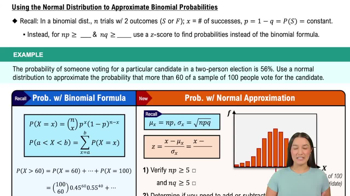
Using the Normal Distribution to Approximate Binomial Probabilities

Mean and Standard Deviation

The mean is the average of a set of values, while the standard deviation measures the amount of variation or dispersion in a set of values. In the context of the final exam grades, the mean of 72 indicates the central tendency, and the standard deviation of 9 indicates how spread out the grades are around the mean. These statistics help assess the distribution of grades.
Recommended video:
Guided course
08:45
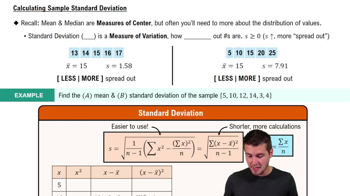
Calculating Standard Deviation

Percentiles

A percentile is a measure used in statistics indicating the value below which a given percentage of observations fall. For example, the 90th percentile score of 93 means that 90% of the students scored below 93. This concept is important for understanding the distribution of grades and assessing whether the data aligns with the characteristics of a normal distribution.
Related Practice
Textbook Question

Finding Probabilities for Normal Distributions In Exercises 7–12, find the indicated probabilities. If convenient, use technology to find the probabilities.


Health Club Schedule The amounts of time per workout an athlete uses a stairclimber are normally distributed, with a mean of 20 minutes and a standard deviation of 5 minutes. Find the probability that a randomly selected athlete uses a stairclimber for (b) between 20 and 28 minutes.

111
views
Textbook Question

Approximating Binomial Probabilities In Exercises 19–26, determine whether you can use a normal distribution to approximate the binomial distribution. If you can, use the normal distribution to approximate the indicated probabilities and sketch their graphs. If you cannot, explain why and use a binomial distribution to find the indicated probabilities. Identify any unusual events. Explain.


Athletes on Social Issues In a survey of college athletes, 84% said they are willing to speak up and be more active in social issues. You randomly select 25 college athletes. Find the probability that the number who are willing to speak up and be more active in social issues is (b) less than 23

102
views
Textbook Question

Finding Probabilities for Normal Distributions In Exercises 7–12, find the indicated probabilities. If convenient, use technology to find the probabilities.


MCAT Scores In a recent year, the MCAT total scores were normally distributed, with a mean of 500.9 and a standard deviation of 10.6. Find the probability that a randomly selected medical student who took the MCAT has a total score that is (b) between 490 and 510. Identify any unusual events in parts (a)–(c). Explain your reasoning. (Source: Association of American Medical Colleges)

137
views
Textbook Question

Finding Specified Data Values In Exercises 31–38, answer the questions about the specified normal distribution.


Weights of Teenagers In a survey of 18-year old males, the mean weight was 166.7 pounds with a standard deviation of 49.3 pounds. (Adapted from National Center for Health Statistics)


c. What weight represents the first quartile?

84
views
Textbook Question

Finding Specified Data Values In Exercises 31–38, answer the questions about the specified normal distribution.


Billboard Hot 100 The length (in seconds) of the 100 most popular songs during the week of May 5, 2021, can be approximated by a normal distribution, as shown in the figure. (Source: Spotify)


b. What song length represents the 17th percentile?

115
views
Textbook Question

Finding Specified Data Values In Exercises 31–38, answer the questions about the specified normal distribution.


COVID-19 Response Surveyors asked respondents to rate ten key aspects of their government’s response to the COVID-19 pandemic, including preparedness, communication, and material aid. A pandemic response score that ranged from 0 to 100 was calculated. The mean score for U.S. respondents was 50.6 with a standard deviation of 29.0. (Source: PLOS One)


b. What score represents the 61st percentile?

69
views