You want to know the favorite spring break destination among 15,000 students at a university. Determine whether you would take a census or use a sampling. If you would use a sampling, determine which sampling technique you would use. Explain your reasoning.
Table of contents
- 1. Intro to Stats and Collecting Data1h 14m
- 2. Describing Data with Tables and Graphs1h 56m
- 3. Describing Data Numerically2h 5m
- 4. Probability2h 17m
- 5. Binomial Distribution & Discrete Random Variables3h 6m
- 6. Normal Distribution and Continuous Random Variables2h 11m
- 7. Sampling Distributions & Confidence Intervals: Mean3h 23m
- Sampling Distribution of the Sample Mean and Central Limit Theorem19m
- Distribution of Sample Mean - ExcelBonus23m
- Introduction to Confidence Intervals15m
- Confidence Intervals for Population Mean1h 18m
- Determining the Minimum Sample Size Required12m
- Finding Probabilities and T Critical Values - ExcelBonus28m
- Confidence Intervals for Population Means - ExcelBonus25m
- 8. Sampling Distributions & Confidence Intervals: Proportion2h 10m
- 9. Hypothesis Testing for One Sample5h 8m
- Steps in Hypothesis Testing1h 6m
- Performing Hypothesis Tests: Means1h 4m
- Hypothesis Testing: Means - ExcelBonus42m
- Performing Hypothesis Tests: Proportions37m
- Hypothesis Testing: Proportions - ExcelBonus27m
- Performing Hypothesis Tests: Variance12m
- Critical Values and Rejection Regions28m
- Link Between Confidence Intervals and Hypothesis Testing12m
- Type I & Type II Errors16m
- 10. Hypothesis Testing for Two Samples5h 37m
- Two Proportions1h 13m
- Two Proportions Hypothesis Test - ExcelBonus28m
- Two Means - Unknown, Unequal Variance1h 3m
- Two Means - Unknown Variances Hypothesis Test - ExcelBonus12m
- Two Means - Unknown, Equal Variance15m
- Two Means - Unknown, Equal Variances Hypothesis Test - ExcelBonus9m
- Two Means - Known Variance12m
- Two Means - Sigma Known Hypothesis Test - ExcelBonus21m
- Two Means - Matched Pairs (Dependent Samples)42m
- Matched Pairs Hypothesis Test - ExcelBonus12m
- Two Variances and F Distribution29m
- Two Variances - Graphing CalculatorBonus16m
- 11. Correlation1h 24m
- 12. Regression3h 33m
- Linear Regression & Least Squares Method26m
- Residuals12m
- Coefficient of Determination12m
- Regression Line Equation and Coefficient of Determination - ExcelBonus8m
- Finding Residuals and Creating Residual Plots - ExcelBonus11m
- Inferences for Slope31m
- Enabling Data Analysis ToolpakBonus1m
- Regression Readout of the Data Analysis Toolpak - ExcelBonus21m
- Prediction Intervals13m
- Prediction Intervals - ExcelBonus19m
- Multiple Regression - ExcelBonus29m
- Quadratic Regression15m
- Quadratic Regression - ExcelBonus10m
- 13. Chi-Square Tests & Goodness of Fit2h 21m
- 14. ANOVA2h 29m
1. Intro to Stats and Collecting Data
Sampling Methods
Problem 1.3.17
Textbook Question
[DATA] Chicago High Schools Open the data set 1_3_17 from www.pearsonhighered.com/sullivanstats. The data set represents a list of every high school in the city of Chicago. Suppose you wish to conduct a survey of all the students enrolled for a simple random sample of 8 high schools in the city of Chicago. Record the name of the 8 high schools (individuals) selected. Write a description of the process you used to generate your sample.
Verified step by step guidance1
Understand that a simple random sample means every high school in the city has an equal chance of being selected, and the selection of one school does not affect the selection of another.
Assign a unique number to each high school in the data set 1_3_17, for example, numbering them from 1 to N, where N is the total number of high schools listed.
Use a random number generator or a random number table to select 8 unique numbers between 1 and N, ensuring no duplicates to maintain randomness and independence.
Match each randomly selected number to the corresponding high school in the data set to identify the 8 schools chosen for the sample.
Record the names of these 8 high schools and write a clear description of your sampling process, including how you assigned numbers and how you generated the random numbers.
Verified video answer for a similar problem:This video solution was recommended by our tutors as helpful for the problem above
Video duration:
6mPlay a video:
0 Comments
Key Concepts
Here are the essential concepts you must grasp in order to answer the question correctly.
Simple Random Sampling
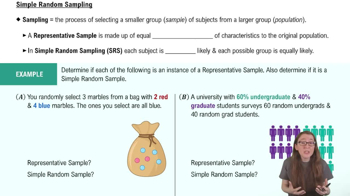
Simple random sampling is a method where every member of the population has an equal chance of being selected. In this context, each high school in Chicago has the same probability of being chosen. This ensures the sample is unbiased and representative of the entire population.
Recommended video:
Simple Random Sampling
Population and Sample
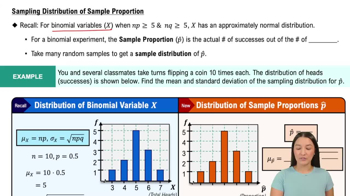
The population is the complete set of all high schools in Chicago, while the sample is the subset of 8 schools selected for the survey. Understanding the difference helps clarify that the sample is used to make inferences about the larger population.
Recommended video:
Sampling Distribution of Sample Proportion
Sampling Procedure Description
Describing the sampling procedure involves explaining the exact steps taken to select the sample, such as using a random number generator or drawing names from a hat. Clear documentation ensures the process is transparent and reproducible.
Recommended video:
Sampling Distribution of Sample Proportion
Related Videos
Related Practice
Textbook Question
123
views