[DATA] Chicago High Schools Open the data set 1_3_17 from www.pearsonhighered.com/sullivanstats. The data set represents a list of every high school in the city of Chicago. Suppose you wish to conduct a survey of all the students enrolled for a simple random sample of 8 high schools in the city of Chicago. Record the name of the 8 high schools (individuals) selected. Write a description of the process you used to generate your sample.
Table of contents
- 1. Intro to Stats and Collecting Data1h 14m
- 2. Describing Data with Tables and Graphs1h 56m
- 3. Describing Data Numerically2h 5m
- 4. Probability2h 17m
- 5. Binomial Distribution & Discrete Random Variables3h 6m
- 6. Normal Distribution and Continuous Random Variables2h 11m
- 7. Sampling Distributions & Confidence Intervals: Mean3h 23m
- Sampling Distribution of the Sample Mean and Central Limit Theorem19m
- Distribution of Sample Mean - ExcelBonus23m
- Introduction to Confidence Intervals15m
- Confidence Intervals for Population Mean1h 18m
- Determining the Minimum Sample Size Required12m
- Finding Probabilities and T Critical Values - ExcelBonus28m
- Confidence Intervals for Population Means - ExcelBonus25m
- 8. Sampling Distributions & Confidence Intervals: Proportion2h 10m
- 9. Hypothesis Testing for One Sample5h 8m
- Steps in Hypothesis Testing1h 6m
- Performing Hypothesis Tests: Means1h 4m
- Hypothesis Testing: Means - ExcelBonus42m
- Performing Hypothesis Tests: Proportions37m
- Hypothesis Testing: Proportions - ExcelBonus27m
- Performing Hypothesis Tests: Variance12m
- Critical Values and Rejection Regions28m
- Link Between Confidence Intervals and Hypothesis Testing12m
- Type I & Type II Errors16m
- 10. Hypothesis Testing for Two Samples5h 37m
- Two Proportions1h 13m
- Two Proportions Hypothesis Test - ExcelBonus28m
- Two Means - Unknown, Unequal Variance1h 3m
- Two Means - Unknown Variances Hypothesis Test - ExcelBonus12m
- Two Means - Unknown, Equal Variance15m
- Two Means - Unknown, Equal Variances Hypothesis Test - ExcelBonus9m
- Two Means - Known Variance12m
- Two Means - Sigma Known Hypothesis Test - ExcelBonus21m
- Two Means - Matched Pairs (Dependent Samples)42m
- Matched Pairs Hypothesis Test - ExcelBonus12m
- Two Variances and F Distribution29m
- Two Variances - Graphing CalculatorBonus16m
- 11. Correlation1h 24m
- 12. Regression3h 33m
- Linear Regression & Least Squares Method26m
- Residuals12m
- Coefficient of Determination12m
- Regression Line Equation and Coefficient of Determination - ExcelBonus8m
- Finding Residuals and Creating Residual Plots - ExcelBonus11m
- Inferences for Slope31m
- Enabling Data Analysis ToolpakBonus1m
- Regression Readout of the Data Analysis Toolpak - ExcelBonus21m
- Prediction Intervals13m
- Prediction Intervals - ExcelBonus19m
- Multiple Regression - ExcelBonus29m
- Quadratic Regression15m
- Quadratic Regression - ExcelBonus10m
- 13. Chi-Square Tests & Goodness of Fit2h 21m
- 14. ANOVA2h 29m
1. Intro to Stats and Collecting Data
Sampling Methods
Problem 1.4.2
Textbook Question
Which sampling method does not require a frame?
Verified step by step guidance1
Understand what a sampling frame is: it is a list or a database of all the members of the population from which a sample is drawn.
Recall that some sampling methods require a complete list of the population (a frame) to select samples, such as simple random sampling or systematic sampling.
Identify sampling methods that do not require a frame, such as convenience sampling, quota sampling, or snowball sampling, where samples are selected without a predefined list.
Focus on the key characteristic of these methods: they rely on accessibility or referrals rather than a complete population list.
Conclude that the sampling method which does not require a frame is typically a non-probability sampling method like convenience sampling.
Verified video answer for a similar problem:This video solution was recommended by our tutors as helpful for the problem above
Video duration:
4mPlay a video:
0 Comments
Key Concepts
Here are the essential concepts you must grasp in order to answer the question correctly.
Sampling Frame
A sampling frame is a list or database containing all members of the population from which a sample is drawn. It serves as a reference to ensure every individual has a chance of selection. Some sampling methods require a complete frame, while others do not.
Recommended video:
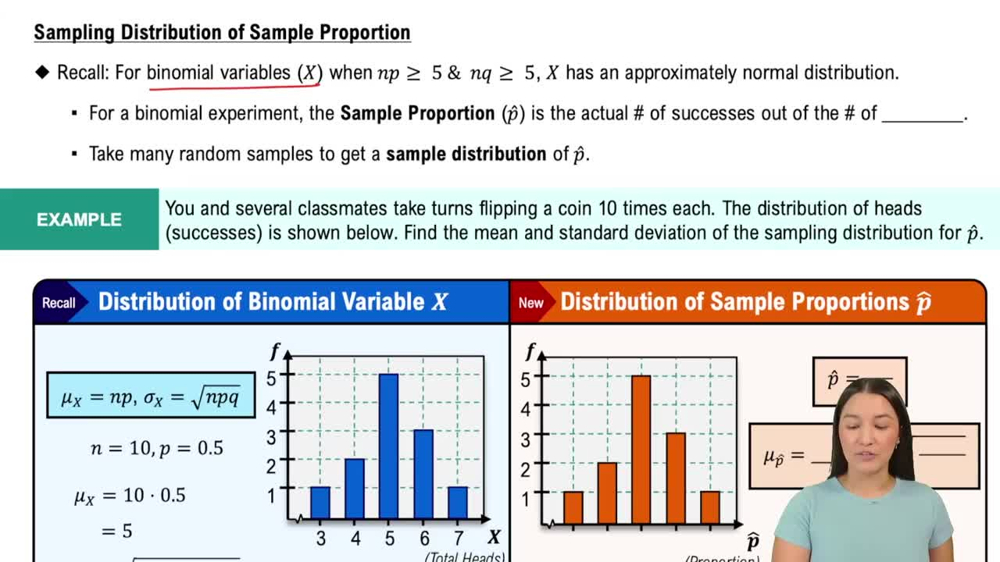
Sampling Distribution of Sample Proportion
Sampling Methods Without a Frame
Certain sampling methods, like convenience sampling or snowball sampling, do not require a predefined list of the population. These methods select samples based on accessibility or referrals, making them useful when a frame is unavailable.
Recommended video:
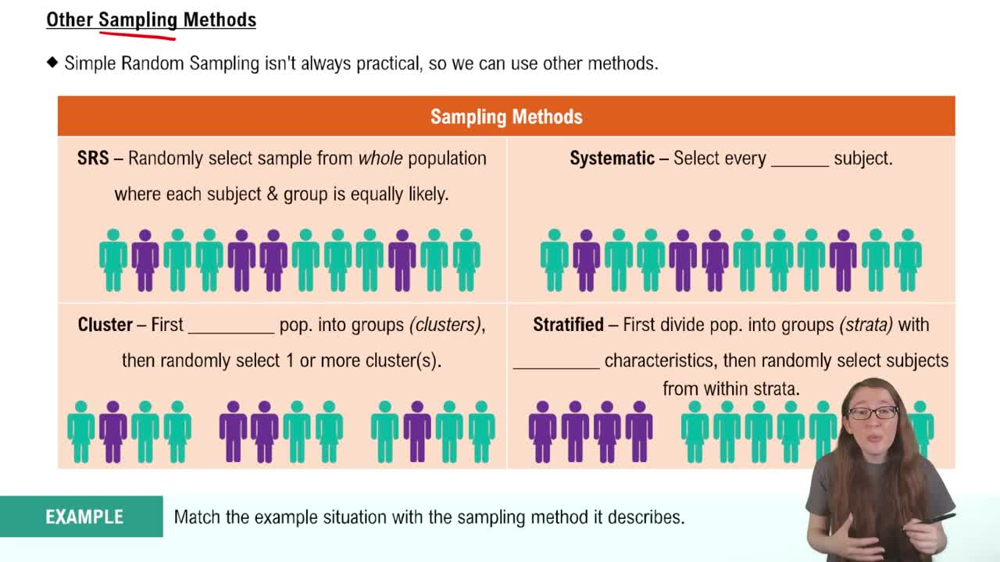
Sampling Methods
Probability vs. Non-Probability Sampling
Probability sampling methods rely on random selection from a known frame, ensuring representativeness. Non-probability sampling methods do not require a frame and often involve subjective selection, which can introduce bias but are practical in some contexts.
Recommended video:
Guided course
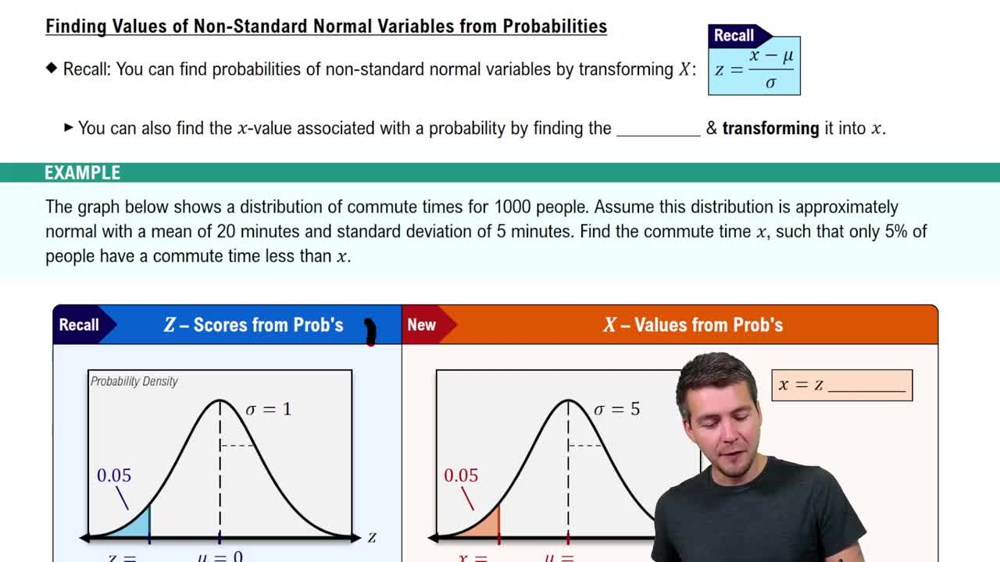
Finding Values of Non-Standard Normal Variables from Probabilities
Related Videos
Related Practice
Textbook Question
19
views