
Textbook Question
"In Exercises 7-12, match the description in the left column with its symbol(s) in the right column.
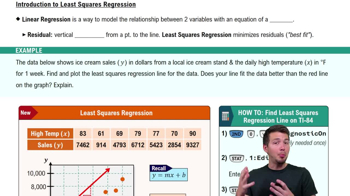
9. Slope
a. \(\hat{y}\)_i
b. y_i
c. b
d. (\(\bar{x}\), \(\bar{y}\))
e. m
f. \(\bar{y}\)"
51
views

 Verified step by step guidance
 07:01
07:01
 06:14
06:14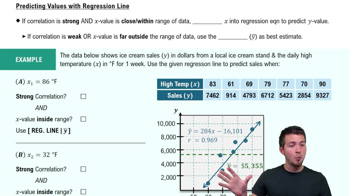 04:57
04:57"In Exercises 7-12, match the description in the left column with its symbol(s) in the right column.
9. Slope
a. \(\hat{y}\)_i
b. y_i
c. b
d. (\(\bar{x}\), \(\bar{y}\))
e. m
f. \(\bar{y}\)"
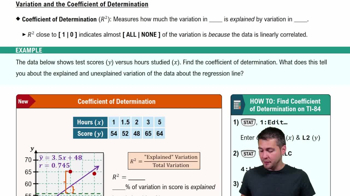
"Old Vehicles In Exercises 31–34, use the figure shown at the left.
33. Coefficient of Determination Find the coefficient of determination r^2 and interpret the results."
2. Describe the range of values for the correlation coefficient.
"In Exercises 19-22, two variables are given that have been shown to have correlation but no cause-and-effect relationship. Describe at least one possible reason for the correlation.
22. Marriage rate in Kentucky and number of deaths caused by falling out of a fishing boat"
8. In your own words, what does it mean to say "correlation does not imply causation"? List a pair of variables that have correlation but no cause-and-effect relationship.
"In Exercises 7-12, match the description in the left column with its symbol(s) in the right column.
12. The point a regression line always passes through
a. \(\hat{y}\)_i
b. y_i
c. b
d. (\(\bar{x}\), \(\bar{y}\))
e. m
f. \(\bar{y}\)"