Which part of the survey described in Exercise 31 represents the descriptive branch of statistics? What conclusions might be drawn from the survey using inferential statistics?
Table of contents
- 1. Intro to Stats and Collecting Data1h 14m
- 2. Describing Data with Tables and Graphs1h 55m
- 3. Describing Data Numerically2h 5m
- 4. Probability2h 16m
- 5. Binomial Distribution & Discrete Random Variables3h 6m
- 6. Normal Distribution and Continuous Random Variables2h 11m
- 7. Sampling Distributions & Confidence Intervals: Mean3h 23m
- Sampling Distribution of the Sample Mean and Central Limit Theorem19m
- Distribution of Sample Mean - Excel23m
- Introduction to Confidence Intervals15m
- Confidence Intervals for Population Mean1h 18m
- Determining the Minimum Sample Size Required12m
- Finding Probabilities and T Critical Values - Excel28m
- Confidence Intervals for Population Means - Excel25m
- 8. Sampling Distributions & Confidence Intervals: Proportion1h 25m
- 9. Hypothesis Testing for One Sample3h 29m
- 10. Hypothesis Testing for Two Samples4h 50m
- Two Proportions1h 13m
- Two Proportions Hypothesis Test - Excel28m
- Two Means - Unknown, Unequal Variance1h 3m
- Two Means - Unknown Variances Hypothesis Test - Excel12m
- Two Means - Unknown, Equal Variance15m
- Two Means - Unknown, Equal Variances Hypothesis Test - Excel9m
- Two Means - Known Variance12m
- Two Means - Sigma Known Hypothesis Test - Excel21m
- Two Means - Matched Pairs (Dependent Samples)42m
- Matched Pairs Hypothesis Test - Excel12m
- 11. Correlation1h 24m
- 12. Regression1h 50m
- 13. Chi-Square Tests & Goodness of Fit2h 21m
- 14. ANOVA1h 57m
1. Intro to Stats and Collecting Data
Intro to Stats
Problem 1.2.13
Textbook Question
"Determine whether the data are qualitative or quantitative. Explain your reasoning.
Distances of track events"
Verified step by step guidance1
Step 1: Understand the difference between qualitative and quantitative data. Qualitative data describes categories or qualities and is non-numerical, while quantitative data represents numerical values and measurements.
Step 2: Analyze the given data, 'Distances of track events.' Distances are numerical values that measure the length of track events, such as 100 meters, 200 meters, etc.
Step 3: Determine whether the data is numerical or categorical. Since distances are expressed in numbers and represent measurable quantities, they are numerical data.
Step 4: Conclude that the data is quantitative because it involves numerical measurements of distances, which can be used for mathematical operations like addition, subtraction, or averaging.
Step 5: Explain the reasoning: Quantitative data is used when the variable being measured is numerical and can be expressed in units, such as meters for track distances. This makes 'Distances of track events' a quantitative variable.
Verified video answer for a similar problem:This video solution was recommended by our tutors as helpful for the problem above
Video duration:
2mPlay a video:
Was this helpful?
Key Concepts
Here are the essential concepts you must grasp in order to answer the question correctly.
Qualitative Data
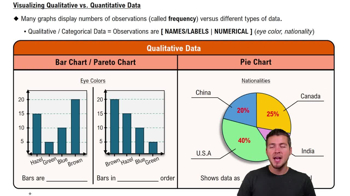
Qualitative data refers to non-numerical information that describes characteristics or qualities. It is often categorical, meaning it can be divided into groups or categories based on attributes. Examples include colors, names, or types of events. Understanding whether data is qualitative helps in determining the appropriate statistical methods for analysis.
Recommended video:
Guided course
Visualizing Qualitative vs. Quantitative Data
Quantitative Data
Quantitative data consists of numerical values that can be measured and expressed mathematically. This type of data can be further classified into discrete (countable) and continuous (measurable) data. Examples include heights, weights, and distances. Recognizing quantitative data is essential for applying statistical techniques such as mean, median, and standard deviation.
Recommended video:
Guided course
Visualizing Qualitative vs. Quantitative Data
Data Classification
Data classification involves categorizing data into qualitative or quantitative types based on their characteristics. This classification is crucial for selecting the right analytical approach and statistical tests. For instance, knowing that distances of track events are quantitative allows for the use of various statistical methods to analyze trends, averages, and variability in the data.
Recommended video:
Introduction to Collecting Data
Watch next
Master Introduction to Statistics Channel with a bite sized video explanation from Patrick
Start learningRelated Videos
Related Practice
Textbook Question
92
views