38. Getting to Work According to a survey, the probability that a randomly selected worker primarily rides a bicycle to work is 0.792. The probability that a randomly selected worker primarily takes public transportation to work is 0.071. (b) What is the probability that a randomly selected worker primarily neither rides a bicycle nor takes public transportation to work?
Verified step by step guidance
1
Identify the given probabilities: the probability that a worker rides a bicycle to work is \(0.792\), and the probability that a worker takes public transportation to work is \(0.071\).
Understand that the problem asks for the probability that a worker neither rides a bicycle nor takes public transportation. This means we want the probability of the complement of the union of these two events.
Calculate the combined probability of a worker either riding a bicycle or taking public transportation. Since these two events are mutually exclusive (a worker primarily uses one mode), add the probabilities: \(P(\text{bicycle or public transport}) = 0.792 + 0.071\).
Use the complement rule to find the probability that a worker neither rides a bicycle nor takes public transportation: \(P(\text{neither}) = 1 - P(\text{bicycle or public transport})\).
Substitute the sum from step 3 into the complement formula from step 4 to express the final probability.
Verified video answer for a similar problem:
This video solution was recommended by our tutors as helpful for the problem above
Video duration:
2m
Play a video:
0 Comments
Key Concepts
Here are the essential concepts you must grasp in order to answer the question correctly.
Probability of Complementary Events
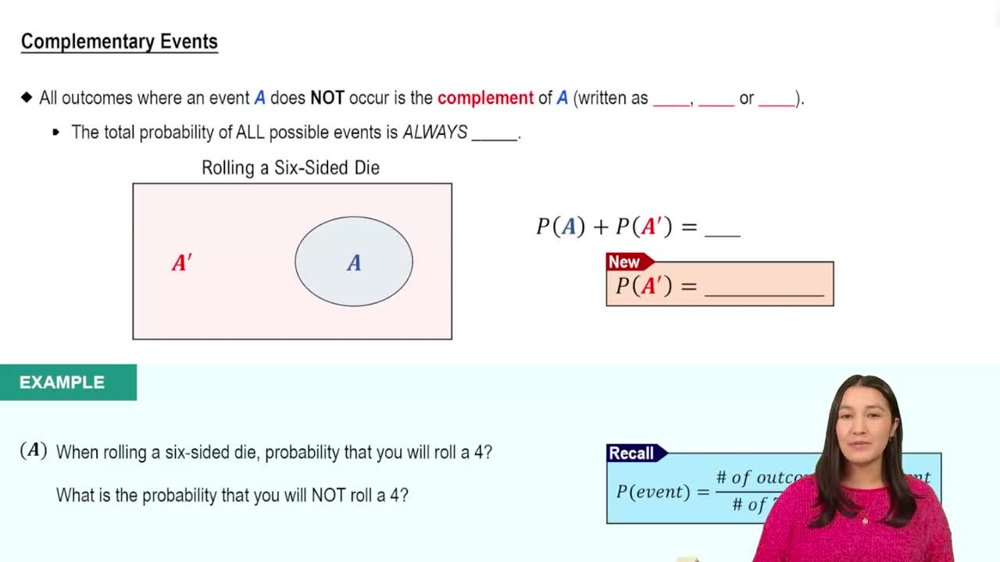
The probability of the complement of an event is 1 minus the probability of the event itself. If an event A represents workers who ride a bicycle or take public transportation, then the probability of neither is 1 minus the probability of A.
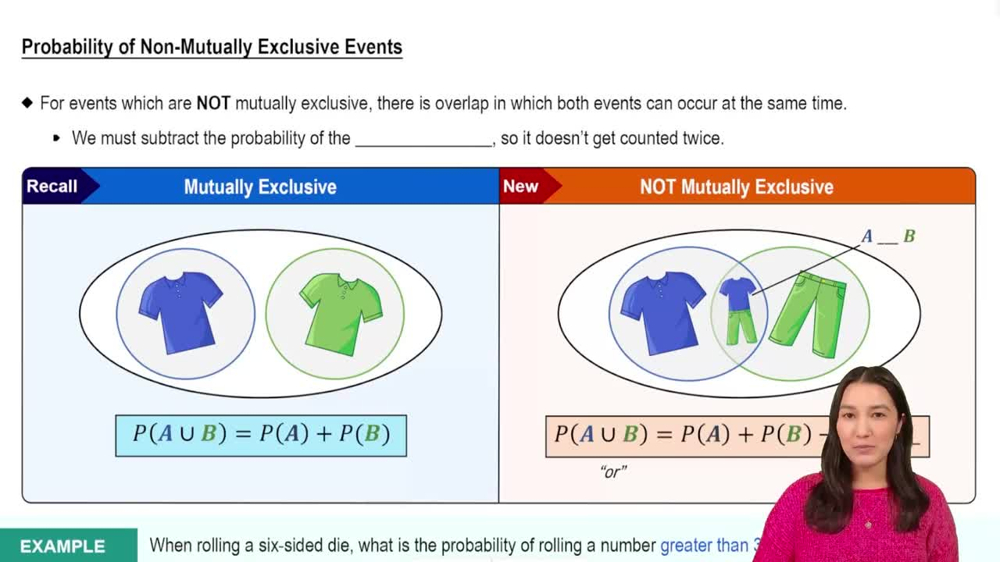
When calculating the probability of either of two mutually exclusive events occurring, you add their individual probabilities. Here, since riding a bicycle and taking public transportation are distinct modes, their probabilities can be summed to find the total probability of either.
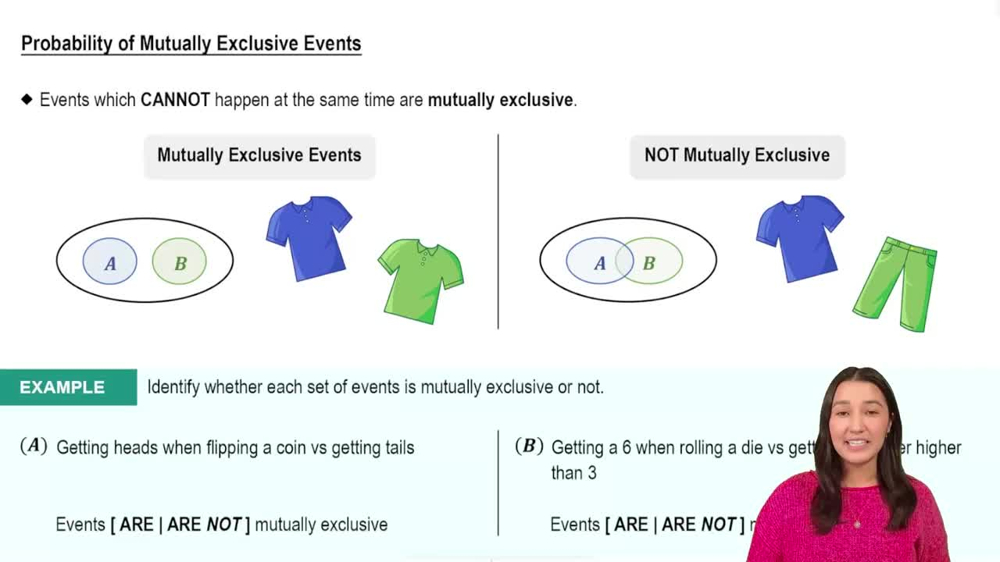
Two events are mutually exclusive if they cannot happen at the same time. In this question, a worker cannot primarily use both a bicycle and public transportation simultaneously, so these events are mutually exclusive, allowing direct addition of their probabilities.

 2:41 minutes
 Verified step by step guidance
 4:23
4:23