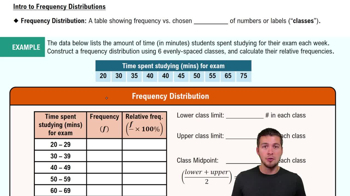
The ________ class limit is the smallest value within the class and ________ the class limit is the largest value within the class.
Table of contents
- 1. Intro to Stats and Collecting Data1h 14m
- 2. Describing Data with Tables and Graphs1h 55m
- 3. Describing Data Numerically2h 5m
- 4. Probability2h 16m
- 5. Binomial Distribution & Discrete Random Variables3h 6m
- 6. Normal Distribution and Continuous Random Variables2h 11m
- 7. Sampling Distributions & Confidence Intervals: Mean3h 23m
- Sampling Distribution of the Sample Mean and Central Limit Theorem19m
- Distribution of Sample Mean - Excel23m
- Introduction to Confidence Intervals15m
- Confidence Intervals for Population Mean1h 18m
- Determining the Minimum Sample Size Required12m
- Finding Probabilities and T Critical Values - Excel28m
- Confidence Intervals for Population Means - Excel25m
- 8. Sampling Distributions & Confidence Intervals: Proportion1h 25m
- 9. Hypothesis Testing for One Sample3h 29m
- 10. Hypothesis Testing for Two Samples4h 50m
- Two Proportions1h 13m
- Two Proportions Hypothesis Test - Excel28m
- Two Means - Unknown, Unequal Variance1h 3m
- Two Means - Unknown Variances Hypothesis Test - Excel12m
- Two Means - Unknown, Equal Variance15m
- Two Means - Unknown, Equal Variances Hypothesis Test - Excel9m
- Two Means - Known Variance12m
- Two Means - Sigma Known Hypothesis Test - Excel21m
- Two Means - Matched Pairs (Dependent Samples)42m
- Matched Pairs Hypothesis Test - Excel12m
- 11. Correlation1h 24m
- 12. Regression1h 50m
- 13. Chi-Square Tests & Goodness of Fit2h 21m
- 14. ANOVA1h 57m
2. Describing Data with Tables and Graphs
Frequency Distributions
Problem 2.2.46
Textbook Question
Why shouldn’t classes overlap when summarizing continuous data in a frequency or relative frequency distribution?
Verified step by step guidance1
Understand that when summarizing continuous data, classes represent intervals that group data points together to show their distribution.
Recognize that if classes overlap, a single data value could fall into more than one class, causing ambiguity about where to count that data point.
Recall that frequency and relative frequency distributions require each data point to be counted exactly once to maintain accuracy and avoid double counting.
Note that non-overlapping classes ensure that the entire range of data is covered without gaps or overlaps, making the distribution clear and mutually exclusive.
Conclude that avoiding overlapping classes preserves the integrity of the data summary, allowing for correct interpretation and further statistical analysis.
Verified video answer for a similar problem:This video solution was recommended by our tutors as helpful for the problem above
Video duration:
2mPlay a video:
Was this helpful?
Key Concepts
Here are the essential concepts you must grasp in order to answer the question correctly.
Class Intervals in Frequency Distributions
Class intervals group continuous data into ranges for easier analysis. Each class represents a specific range of values, and data points falling within that range are counted to determine frequency. Properly defined classes help summarize large datasets effectively.
Recommended video:
Guided course
Intro to Frequency Distributions
Non-Overlapping Classes
Classes should not overlap to avoid ambiguity in data classification. Overlapping classes cause confusion about which class a data point belongs to, leading to inaccurate frequency counts and misinterpretation of the distribution.
Recommended video:
Guided course
Finding Z-Scores for Non-Standard Normal Variables
Continuous Data and Class Boundaries
Continuous data can take any value within a range, so class boundaries must be clearly defined without overlap. Using precise boundaries ensures each data value fits into one and only one class, maintaining the integrity of the frequency or relative frequency distribution.
Recommended video:
Introduction to Collecting Data
Watch next
Master Intro to Frequency Distributions with a bite sized video explanation from Patrick
Start learningRelated Videos
Related Practice
Textbook Question
4
views