
Ch. 2 - Descriptive Statistics
Larson - Elementary Statistics: Picturing the World 8th Edition
Larson8th EditionElementary Statistics: Picturing the WorldISBN: 9780137493470Not the one you use?Change textbook
Chapter 2, Problem 2.3.22

Using and Interpreting Concepts


Finding and Discussing the Mean, Median, and Mode In Exercises 17–34, find the mean, the median, and the mode of the data, if possible. If any measure cannot be found or does not represent the center of the data, explain why.


Cholesterol The cholesterol levels of a sample of 10 female employees
154 240 171 188 235 203 184 173 181 275

Verified step by step guidance
1
Step 1: Organize the data in ascending order to make calculations easier. The cholesterol levels are: 154, 171, 173, 181, 184, 188, 203, 235, 240, 275.
Step 2: Calculate the mean (average). Add all the cholesterol levels together and divide by the total number of data points (10). Use the formula: xn, where x is the sum of the data points and n is the number of data points.
Step 3: Find the median. Since there are 10 data points (an even number), the median is the average of the two middle values. Identify the two middle values in the ordered data set and calculate their average using the formula: x5+x62, where x5 and x6 are the fifth and sixth values in the ordered data set.
Step 4: Determine the mode. The mode is the value that appears most frequently in the data set. Check the frequency of each cholesterol level in the ordered data set. If no value repeats, then the data set has no mode.
Step 5: Interpret the results. Discuss whether the mean, median, and mode represent the center of the data effectively. Consider factors such as the presence of outliers (e.g., 275) and whether the measures of central tendency provide a meaningful summary of the data distribution.

Verified video answer for a similar problem:

This video solution was recommended by our tutors as helpful for the problem above.
Video duration:
4m
Was this helpful?

Key Concepts

Here are the essential concepts you must grasp in order to answer the question correctly.

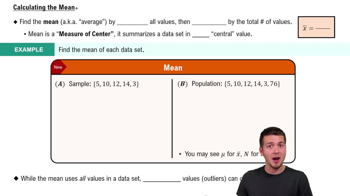
Mean

The mean, often referred to as the average, is calculated by summing all the values in a dataset and dividing by the number of values. It provides a central value that represents the dataset but can be influenced by extreme values (outliers). For example, in the cholesterol levels provided, the mean gives a general idea of the average cholesterol level among the employees.
Recommended video:
Guided course
04:52
Calculating the Mean

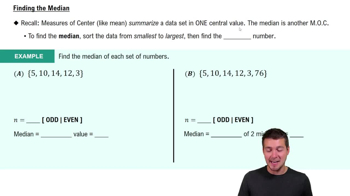
Median

The median is the middle value of a dataset when it is ordered from least to greatest. If there is an even number of observations, the median is the average of the two middle numbers. This measure is particularly useful for understanding the center of a dataset that may have outliers, as it is not affected by extreme values. In the cholesterol data, finding the median helps to identify a central tendency that is more representative of the majority of the values.
Recommended video:
Guided course
03:26
Calculating the Median

Mode

The mode is the value that appears most frequently in a dataset. A dataset may have one mode, more than one mode (bimodal or multimodal), or no mode at all if all values are unique. In the context of cholesterol levels, identifying the mode can highlight the most common cholesterol level among the employees, providing insight into typical health metrics within the group.
Recommended video:
Guided course
07:10
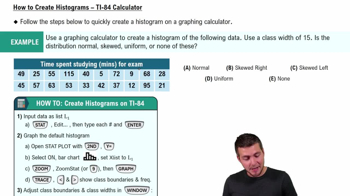
How to Create Histogram - TI-84 Calculator
Related Practice
Textbook Question

Using and Interpreting Concepts


Finding and Discussing the Mean, Median, and Mode In Exercises 17–34, find the mean, the median, and the mode of the data, if possible. If any measure cannot be found or does not represent the center of the data, explain why.


Judicial System The responses of a sample of 34 young adult United Kingdom males in custodial sentences who were asked what is affected by such sentences (Adapted from User Voice)

Mental health: 8

Trust: 3

Education: 8

Personal development: 5

Family: 3

Future opportunities: 3

Other: 4

134
views
Textbook Question

Building Basic Skills and Vocabulary


True or False? In Exercises 1–4, determine whether the statement is true or false. If it is false, rewrite it as a true statement.


A data set can have the same mean, median, and mode.

103
views
Textbook Question

Using Chebychev’s Theorem Old Faithful is a famous geyser at Yellowstone National Park. From a sample with n = 100, the mean interval between Old Faithful’s eruptions is 101.56 minutes and the standard deviation is 42.69 minutes. Using Chebychev’s Theorem, determine at least how many of the intervals lasted between 16.18 minutes and 186.94 minutes. (Adapted from Geyser Times)

278
views
Textbook Question

True or False? In Exercises 7–10, determine whether the statement is true or false. If it is false, rewrite it as a true statement.


It is impossible to have a z-score of 0.

198
views
Textbook Question

Using Technology to Find Quartiles and Draw Graphs In Exercises 23–26, use technology to draw a box-and-whisker plot that represents the data set.


Vacation Days The number of vacation days used by a sample of 20 employees in a recent year

3 9 2 1 7 5 3 2 2 6

4 0 10 0 3 5 7 8 6 5

150
views
Textbook Question

Estimating Standard Deviation Both data sets shown in the stem-and-leaf plots have a mean of 165. One has a standard deviation of 16, and the other has a standard deviation of 24. By looking at the stem-and-leaf plots, which is which? Explain your reasoning.


129
views