
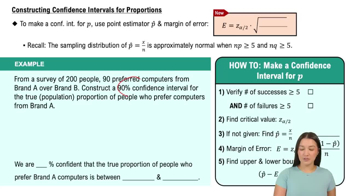
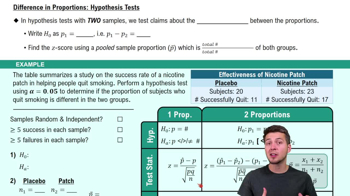
Step 1: Define the null hypothesis (H₀) and the alternative hypothesis (Hₐ). The null hypothesis typically states that the population proportion p is equal to a specific value (e.g., H₀: p = p₀), while the alternative hypothesis specifies whether p is different, greater, or less than p₀ (e.g., Hₐ: p ≠ p₀, Hₐ: p > p₀, or Hₐ: p < p₀).
Step 2: Choose the significance level (α), which represents the probability of rejecting the null hypothesis when it is true. Common values for α are 0.05, 0.01, or 0.10.
Step 3: Calculate the test statistic using the formula: , where p is the sample proportion, p₀ is the hypothesized population proportion, and n is the sample size.
Step 4: Determine the critical value(s) or p-value based on the chosen significance level and the type of test (one-tailed or two-tailed). Use the standard normal distribution (Z-distribution) to find these values.
Step 5: Compare the test statistic to the critical value(s) or use the p-value to make a decision. If the test statistic falls in the rejection region or if the p-value is less than α, reject the null hypothesis. Otherwise, fail to reject the null hypothesis.
Verified video answer for a similar problem:
This video solution was recommended by our tutors as helpful for the problem above
Video duration:
1m
Play a video:
0 Comments
Key Concepts
Here are the essential concepts you must grasp in order to answer the question correctly.
Population Proportion
The population proportion, denoted as p, is the ratio of members in a population that possess a certain characteristic. It is a key parameter in statistics, particularly in hypothesis testing and confidence interval estimation. Understanding the population proportion is essential for determining how representative a sample is of the entire population.
Hypothesis testing is a statistical method used to make inferences about population parameters based on sample data. In the context of testing a population proportion, it involves formulating a null hypothesis (H0) that states there is no effect or difference, and an alternative hypothesis (H1) that suggests otherwise. The outcome of the test helps determine whether to reject or fail to reject the null hypothesis.
The Z-test for proportions is a statistical test used to determine if the observed sample proportion significantly differs from a hypothesized population proportion. This test calculates a Z-score, which measures how many standard deviations the sample proportion is from the hypothesized proportion. It is essential for assessing the significance of the results and making informed conclusions about the population.