Explain how to test a population proportion p.
Table of contents
- 1. Intro to Stats and Collecting Data1h 14m
- 2. Describing Data with Tables and Graphs1h 55m
- 3. Describing Data Numerically2h 5m
- 4. Probability2h 16m
- 5. Binomial Distribution & Discrete Random Variables3h 6m
- 6. Normal Distribution and Continuous Random Variables2h 11m
- 7. Sampling Distributions & Confidence Intervals: Mean3h 23m
- Sampling Distribution of the Sample Mean and Central Limit Theorem19m
- Distribution of Sample Mean - Excel23m
- Introduction to Confidence Intervals15m
- Confidence Intervals for Population Mean1h 18m
- Determining the Minimum Sample Size Required12m
- Finding Probabilities and T Critical Values - Excel28m
- Confidence Intervals for Population Means - Excel25m
- 8. Sampling Distributions & Confidence Intervals: Proportion1h 25m
- 9. Hypothesis Testing for One Sample3h 29m
- 10. Hypothesis Testing for Two Samples4h 50m
- Two Proportions1h 13m
- Two Proportions Hypothesis Test - Excel28m
- Two Means - Unknown, Unequal Variance1h 3m
- Two Means - Unknown Variances Hypothesis Test - Excel12m
- Two Means - Unknown, Equal Variance15m
- Two Means - Unknown, Equal Variances Hypothesis Test - Excel9m
- Two Means - Known Variance12m
- Two Means - Sigma Known Hypothesis Test - Excel21m
- Two Means - Matched Pairs (Dependent Samples)42m
- Matched Pairs Hypothesis Test - Excel12m
- 11. Correlation1h 24m
- 12. Regression1h 50m
- 13. Chi-Square Tests & Goodness of Fit2h 21m
- 14. ANOVA1h 57m
9. Hypothesis Testing for One Sample
Performing Hypothesis Tests: Proportions
Problem 7.4.6
Textbook Question
In Exercises 3–6, determine whether a normal sampling distribution can be used. If it can be used, test the claim.
Claim: p > 0.70, α=0.04. Sample statistics: p_hat = 0.64, n=225
Verified step by step guidance1
Step 1: Verify the conditions for using a normal sampling distribution. The two conditions are: (1) The sample size n must be large enough such that both n * p and n * (1 - p) are greater than or equal to 5, where p is the hypothesized population proportion. (2) The sampling must be random and independent.
Step 2: Calculate the standard error (SE) of the sampling distribution of the sample proportion using the formula: SE = sqrt((p * (1 - p)) / n), where p is the hypothesized population proportion and n is the sample size.
Step 3: Compute the z-test statistic using the formula: z = (p_hat - p) / SE, where p_hat is the sample proportion, p is the hypothesized population proportion, and SE is the standard error calculated in Step 2.
Step 4: Determine the critical value for the given significance level α = 0.04. Since the claim is one-tailed (p > 0.70), find the z-critical value corresponding to the upper tail of the standard normal distribution.
Step 5: Compare the z-test statistic to the z-critical value. If the z-test statistic is greater than the z-critical value, reject the null hypothesis. Otherwise, fail to reject the null hypothesis. Interpret the result in the context of the claim.
Verified video answer for a similar problem:This video solution was recommended by our tutors as helpful for the problem above
Video duration:
4mPlay a video:
Was this helpful?
Key Concepts
Here are the essential concepts you must grasp in order to answer the question correctly.
Normal Sampling Distribution
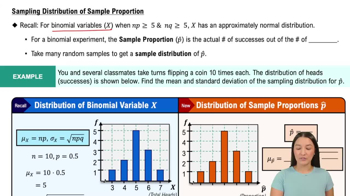
A normal sampling distribution is a probability distribution of sample means or proportions that approaches a normal distribution as the sample size increases, according to the Central Limit Theorem. For proportions, this is applicable when both np and n(1-p) are greater than 5, ensuring that the sample size is sufficiently large to approximate normality.
Recommended video:
Sampling Distribution of Sample Proportion
Hypothesis Testing
Hypothesis testing is a statistical method used to make decisions about a population based on sample data. It involves formulating a null hypothesis (H0) and an alternative hypothesis (H1), then using sample statistics to determine whether to reject H0 in favor of H1, based on a predetermined significance level (α).
Recommended video:
Guided course
Step 1: Write Hypotheses
Significance Level (α)
The significance level (α) is the threshold for determining whether a result is statistically significant. It represents the probability of rejecting the null hypothesis when it is actually true (Type I error). In this case, α=0.04 indicates a 4% risk of making such an error, guiding the decision-making process in hypothesis testing.
Recommended video:
Guided course
Step 4: State Conclusion Example 4
Watch next
Master Performing Hypothesis Tests: Proportions with a bite sized video explanation from Patrick
Start learningRelated Videos
Related Practice
Textbook Question
24
views