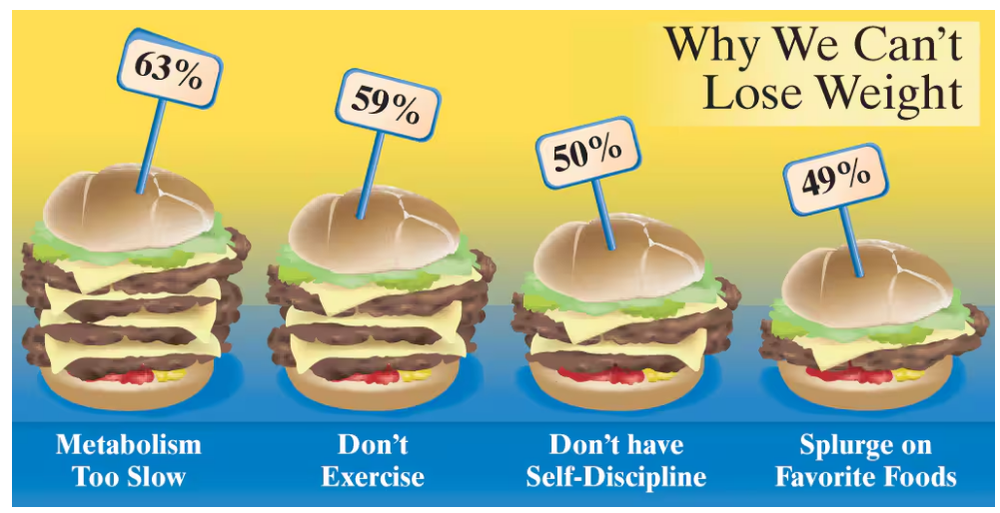
Consider the information in the chart shown below, which is in the USA Today style of graph. Could the information provided be organized into a pie chart? Why or why not?
Verified step by step guidance
1
Step 1: Understand the data categories and their percentages. The chart shows four reasons why people can't lose weight, each with a percentage: Metabolism Too Slow (63%), Don't Exercise (59%), Don't have Self-Discipline (50%), and Splurge on Favorite Foods (49%).
Step 2: Recognize that a pie chart represents parts of a whole, where all categories combined should sum to 100%. This allows the pie chart to show the proportion of each category relative to the total.
Step 3: Add the given percentages to check if they sum to 100%. Calculate 63% + 59% + 50% + 49% to see if the total equals 100%.
Step 4: Since the sum of these percentages is greater than 100%, it indicates that these categories are not mutually exclusive (people may fall into more than one category). Therefore, the data cannot be represented as parts of a single whole.
Step 5: Conclude that because the percentages overlap and do not sum to 100%, the information cannot be organized into a pie chart, which requires mutually exclusive categories that sum to 100%.
Verified video answer for a similar problem:
This video solution was recommended by our tutors as helpful for the problem above
Video duration:
6m
Play a video:
Was this helpful?
Key Concepts
Here are the essential concepts you must grasp in order to answer the question correctly.
Types of Data Representation
Data can be represented in various graphical forms such as bar charts, pie charts, and histograms. Each type is suitable for different kinds of data; pie charts are best for showing parts of a whole, while bar charts can compare different categories independently.
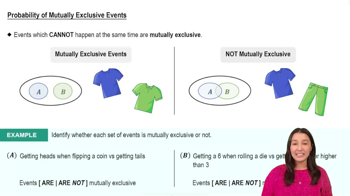
For data to be represented in a pie chart, the categories must be mutually exclusive (no overlap) and collectively exhaustive (sum to 100%). This ensures that the pie chart accurately reflects the proportion of each category within the whole.
Percentages in a chart must be interpreted carefully to understand what they represent. If percentages do not add up to 100%, or if categories overlap, the data cannot be accurately shown in a pie chart, which requires the total to be divided into non-overlapping parts.