
In Exercises 17–19, use the data set, which represents the points recorded by each player on the Winnipeg Jets in the 2019–2020 NHL season. (Source: National Hockey League) 8 8 8 6 0 73 26 1 0 5 58 1 7 5 10 63 0 5 10 0 31 5 15 45 16 29 10 73 5 3 0 65
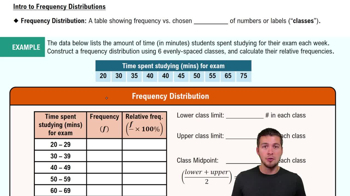
Construct a frequency distribution for the data set using eight classes. Include class limits, midpoints, boundaries, frequencies, relative frequencies, and cumulative frequencies.
Verified step by step guidance
1
Step 1: Determine the range of the data set by subtracting the smallest value from the largest value. This will help in constructing the classes.
Step 2: Divide the range by the number of classes (8 in this case) to calculate the class width. Round up to the nearest whole number if necessary.
Step 3: Define the class limits for each of the eight classes. Start with the smallest value as the lower limit of the first class, and add the class width to determine the upper limit of each class.
Step 4: Calculate the midpoints for each class using the formula: midpoint = (lower limit + upper limit) / 2.
Step 5: Count the number of data points that fall within each class to determine the frequencies. Then calculate the relative frequencies (frequency / total number of data points) and cumulative frequencies (sum of frequencies up to that class).
Verified video answer for a similar problem:
This video solution was recommended by our tutors as helpful for the problem above
Video duration:
4m
Play a video:
0 Comments
Key Concepts
Here are the essential concepts you must grasp in order to answer the question correctly.
Frequency Distribution
A frequency distribution is a summary of how often each value occurs in a dataset. It organizes data into classes or intervals, showing the number of observations (frequency) that fall within each class. This helps in visualizing the distribution of data points and identifying patterns or trends.
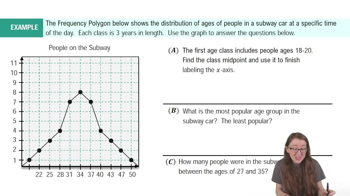
Class limits define the range of values that fall into each class in a frequency distribution. The midpoint of a class is calculated as the average of the upper and lower class limits, providing a representative value for that class. These concepts are essential for summarizing data and facilitating further statistical analysis.
Relative frequency is the proportion of the total number of observations that fall within a specific class, calculated by dividing the class frequency by the total number of observations. Cumulative frequency, on the other hand, is the running total of frequencies up to a certain class, allowing for the analysis of data distribution across multiple classes. Both are important for understanding the overall distribution of data.