When should relative frequencies be used when comparing two data sets? Why?
Table of contents
- 1. Intro to Stats and Collecting Data1h 14m
- 2. Describing Data with Tables and Graphs1h 55m
- 3. Describing Data Numerically2h 5m
- 4. Probability2h 16m
- 5. Binomial Distribution & Discrete Random Variables3h 6m
- 6. Normal Distribution and Continuous Random Variables2h 11m
- 7. Sampling Distributions & Confidence Intervals: Mean3h 23m
- Sampling Distribution of the Sample Mean and Central Limit Theorem19m
- Distribution of Sample Mean - Excel23m
- Introduction to Confidence Intervals15m
- Confidence Intervals for Population Mean1h 18m
- Determining the Minimum Sample Size Required12m
- Finding Probabilities and T Critical Values - Excel28m
- Confidence Intervals for Population Means - Excel25m
- 8. Sampling Distributions & Confidence Intervals: Proportion1h 25m
- 9. Hypothesis Testing for One Sample3h 29m
- 10. Hypothesis Testing for Two Samples4h 50m
- Two Proportions1h 13m
- Two Proportions Hypothesis Test - Excel28m
- Two Means - Unknown, Unequal Variance1h 3m
- Two Means - Unknown Variances Hypothesis Test - Excel12m
- Two Means - Unknown, Equal Variance15m
- Two Means - Unknown, Equal Variances Hypothesis Test - Excel9m
- Two Means - Known Variance12m
- Two Means - Sigma Known Hypothesis Test - Excel21m
- Two Means - Matched Pairs (Dependent Samples)42m
- Matched Pairs Hypothesis Test - Excel12m
- 11. Correlation1h 24m
- 12. Regression1h 50m
- 13. Chi-Square Tests & Goodness of Fit2h 21m
- 14. ANOVA1h 57m
2. Describing Data with Tables and Graphs
Frequency Distributions
Problem 2.1.24f
Textbook Question
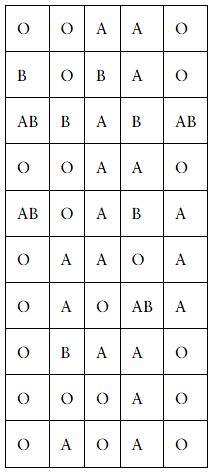
Blood Type A phlebotomist draws the blood of a random sample of 50 patients and determines their blood types as shown:

f. Contact a local hospital and ask them the percentage of the population that is blood type O. Why might the results differ?
Verified step by step guidance1
Step 1: Count the number of patients with blood type O in the sample. Go through each entry in the table and tally how many times 'O' appears.
Step 2: Calculate the sample proportion of blood type O by dividing the count of blood type O patients by the total number of patients sampled (which is 50). Use the formula: \(\text{Proportion of O} = \frac{\text{Number of O patients}}{50}\).
Step 3: Contact the local hospital to obtain the percentage of the population that has blood type O. This percentage represents the population proportion of blood type O.
Step 4: Compare the sample proportion from the phlebotomist's data to the population proportion from the hospital. Consider reasons why these two values might differ, such as sampling variability, sample size, or differences in the population from which the sample was drawn.
Step 5: Reflect on factors like sampling bias, demographic differences, or random chance that can cause the sample proportion to differ from the true population proportion.
Verified video answer for a similar problem:This video solution was recommended by our tutors as helpful for the problem above
Video duration:
5mPlay a video:
Was this helpful?
Key Concepts
Here are the essential concepts you must grasp in order to answer the question correctly.
Sampling Variability
Sampling variability refers to the natural differences that occur when different samples are taken from the same population. Because the phlebotomist's sample is random and relatively small (50 patients), the observed blood type proportions may differ from the true population percentages due to chance.
Recommended video:
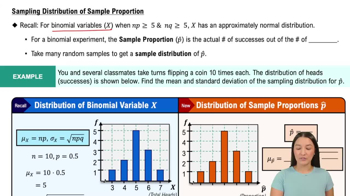
Sampling Distribution of Sample Proportion
Population vs. Sample
A population includes all individuals of interest, while a sample is a subset selected for study. The hospital's reported blood type percentages represent the population, which is typically larger and more comprehensive than the phlebotomist's sample, leading to potential differences in results.
Recommended video:
Sampling Distribution of Sample Proportion
Bias and Representativeness
Bias occurs when a sample does not accurately represent the population. Factors like location, demographics, or sampling method can cause the phlebotomist's sample to differ from the hospital's data, affecting the observed blood type distribution and causing discrepancies.
Recommended video:
Guided course
Step 3: Get P-Value Example 3
Watch next
Master Intro to Frequency Distributions with a bite sized video explanation from Patrick
Start learningRelated Videos
Related Practice
Textbook Question
6
views