What happens to the probability of making a Type II error, β, as the level of significance, α, decreases? Why?
Table of contents
- 1. Intro to Stats and Collecting Data1h 14m
- 2. Describing Data with Tables and Graphs1h 56m
- 3. Describing Data Numerically2h 5m
- 4. Probability2h 16m
- 5. Binomial Distribution & Discrete Random Variables3h 6m
- 6. Normal Distribution and Continuous Random Variables2h 11m
- 7. Sampling Distributions & Confidence Intervals: Mean3h 23m
- Sampling Distribution of the Sample Mean and Central Limit Theorem19m
- Distribution of Sample Mean - ExcelBonus23m
- Introduction to Confidence Intervals15m
- Confidence Intervals for Population Mean1h 18m
- Determining the Minimum Sample Size Required12m
- Finding Probabilities and T Critical Values - ExcelBonus28m
- Confidence Intervals for Population Means - ExcelBonus25m
- 8. Sampling Distributions & Confidence Intervals: Proportion2h 10m
- 9. Hypothesis Testing for One Sample5h 8m
- Steps in Hypothesis Testing1h 6m
- Performing Hypothesis Tests: Means1h 4m
- Hypothesis Testing: Means - ExcelBonus42m
- Performing Hypothesis Tests: Proportions37m
- Hypothesis Testing: Proportions - ExcelBonus27m
- Performing Hypothesis Tests: Variance12m
- Critical Values and Rejection Regions28m
- Link Between Confidence Intervals and Hypothesis Testing12m
- Type I & Type II Errors16m
- 10. Hypothesis Testing for Two Samples5h 37m
- Two Proportions1h 13m
- Two Proportions Hypothesis Test - ExcelBonus28m
- Two Means - Unknown, Unequal Variance1h 3m
- Two Means - Unknown Variances Hypothesis Test - ExcelBonus12m
- Two Means - Unknown, Equal Variance15m
- Two Means - Unknown, Equal Variances Hypothesis Test - ExcelBonus9m
- Two Means - Known Variance12m
- Two Means - Sigma Known Hypothesis Test - ExcelBonus21m
- Two Means - Matched Pairs (Dependent Samples)42m
- Matched Pairs Hypothesis Test - ExcelBonus12m
- Two Variances and F Distribution29m
- Two Variances - Graphing CalculatorBonus16m
- 11. Correlation1h 24m
- 12. Regression3h 33m
- Linear Regression & Least Squares Method26m
- Residuals12m
- Coefficient of Determination12m
- Regression Line Equation and Coefficient of Determination - ExcelBonus8m
- Finding Residuals and Creating Residual Plots - ExcelBonus11m
- Inferences for Slope31m
- Enabling Data Analysis ToolpakBonus1m
- Regression Readout of the Data Analysis Toolpak - ExcelBonus21m
- Prediction Intervals13m
- Prediction Intervals - ExcelBonus19m
- Multiple Regression - ExcelBonus29m
- Quadratic Regression15m
- Quadratic Regression - ExcelBonus10m
- 13. Chi-Square Tests & Goodness of Fit2h 21m
- 14. ANOVA2h 28m
9. Hypothesis Testing for One Sample
Type I & Type II Errors
Problem 10.2B.30d
Textbook Question
"Simulation Simulate drawing 100 simple random samples of size n = 40 from a population whose proportion is 0.3.
d. How do we know that a rejection of the null hypothesis results in making a Type I error in this situation?"
Verified step by step guidance1
Understand the context: The null hypothesis typically states that the population proportion is equal to a specific value (here, 0.3). When we perform hypothesis testing, we either reject or fail to reject this null hypothesis based on sample data.
Recall the definition of a Type I error: It occurs when we reject the null hypothesis even though it is actually true. In other words, we mistakenly conclude there is an effect or difference when there isn't one.
In this simulation, since the population proportion is truly 0.3 (the null hypothesis is true), any rejection of the null hypothesis based on the sample data is an incorrect decision.
Therefore, each time the null hypothesis is rejected in this scenario, it corresponds to a Type I error because the true population proportion matches the null hypothesis value.
To summarize, a rejection of the null hypothesis results in a Type I error here because the null hypothesis is actually true, and rejecting it means making a false positive conclusion.
Verified video answer for a similar problem:This video solution was recommended by our tutors as helpful for the problem above
Video duration:
7mPlay a video:
0 Comments
Key Concepts
Here are the essential concepts you must grasp in order to answer the question correctly.
Type I Error
A Type I error occurs when we reject a true null hypothesis, meaning we conclude there is an effect or difference when there actually isn't. It is also called a false positive, and its probability is denoted by the significance level (alpha).
Recommended video:
Guided course
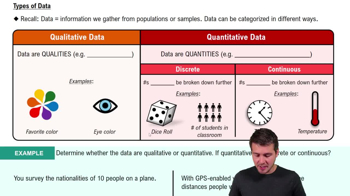
Types of Data
Null Hypothesis in Hypothesis Testing
The null hypothesis (H0) is a statement of no effect or no difference, serving as the default assumption in hypothesis testing. Rejecting H0 suggests evidence against it, but this decision can sometimes be incorrect, leading to errors.
Recommended video:
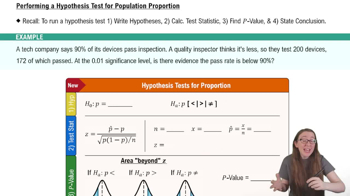
Performing Hypothesis Tests: Proportions
Sampling Distribution and Random Sampling
Sampling distribution describes the distribution of a statistic (like sample proportion) over many random samples from the population. Simple random sampling ensures each sample is representative, allowing us to assess variability and make probabilistic conclusions.
Recommended video:
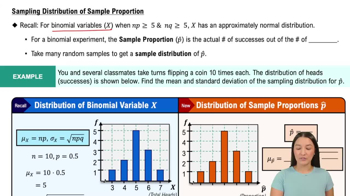
Sampling Distribution of Sample Proportion
Related Videos
Related Practice
Textbook Question
72
views