Threaded Problem: Tornado The data set “Tornadoes_2017” located at www.pearsonhighered.com/sullivanstats contains a variety of variables that were measured for all tornadoes in the United States in 2017. b. Determine the interquartile range of the length of tornadoes in Iowa (IA). Hint: If you are using StatCrunch, enter “State=IA” in the Where: box of the Summary Stats dialogue window. Determine the interquartile range of the length of tornadoes in Kansas (KS). Which state has lengths of tornadoes that are more dispersed? Explain.
Table of contents
- 1. Intro to Stats and Collecting Data1h 14m
- 2. Describing Data with Tables and Graphs1h 55m
- 3. Describing Data Numerically2h 5m
- 4. Probability2h 16m
- 5. Binomial Distribution & Discrete Random Variables3h 6m
- 6. Normal Distribution and Continuous Random Variables2h 11m
- 7. Sampling Distributions & Confidence Intervals: Mean3h 23m
- Sampling Distribution of the Sample Mean and Central Limit Theorem19m
- Distribution of Sample Mean - Excel23m
- Introduction to Confidence Intervals15m
- Confidence Intervals for Population Mean1h 18m
- Determining the Minimum Sample Size Required12m
- Finding Probabilities and T Critical Values - Excel28m
- Confidence Intervals for Population Means - Excel25m
- 8. Sampling Distributions & Confidence Intervals: Proportion1h 25m
- 9. Hypothesis Testing for One Sample3h 29m
- 10. Hypothesis Testing for Two Samples4h 50m
- Two Proportions1h 13m
- Two Proportions Hypothesis Test - Excel28m
- Two Means - Unknown, Unequal Variance1h 3m
- Two Means - Unknown Variances Hypothesis Test - Excel12m
- Two Means - Unknown, Equal Variance15m
- Two Means - Unknown, Equal Variances Hypothesis Test - Excel9m
- Two Means - Known Variance12m
- Two Means - Sigma Known Hypothesis Test - Excel21m
- Two Means - Matched Pairs (Dependent Samples)42m
- Matched Pairs Hypothesis Test - Excel12m
- 11. Correlation1h 24m
- 12. Regression1h 50m
- 13. Chi-Square Tests & Goodness of Fit2h 21m
- 14. ANOVA1h 57m
3. Describing Data Numerically
Percentiles & Quartiles
Problem 3.T.11
Textbook Question
According to the National Center for Health Statistics, a 10-year-old male whose height is 53.5 inches has a height that is at the 15th percentile. Explain what this means.
Verified step by step guidance1
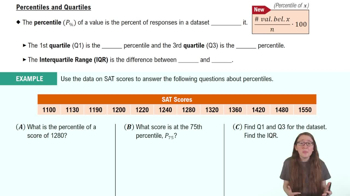
Understand that a percentile indicates the relative standing of a value within a data set. Specifically, the 15th percentile means that 15% of the population has a value less than or equal to this height.
Interpret the given information: a 10-year-old male with a height of 53.5 inches is at the 15th percentile, which means that 15% of 10-year-old males are 53.5 inches tall or shorter.
Recognize that this also implies that 85% of 10-year-old males are taller than 53.5 inches, since percentiles divide the population into parts based on height.
Note that percentiles are useful for comparing an individual's measurement to a reference population, helping to understand how typical or atypical the measurement is.
Summarize that being at the 15th percentile means the child's height is below average compared to peers, but still within the normal range of variation.
Verified video answer for a similar problem:This video solution was recommended by our tutors as helpful for the problem above
Video duration:
2mPlay a video:
Was this helpful?
Key Concepts
Here are the essential concepts you must grasp in order to answer the question correctly.
Percentiles
A percentile indicates the relative standing of a value within a data set. For example, being at the 15th percentile means that 15% of the population has a height less than or equal to 53.5 inches, and 85% are taller. Percentiles help compare individual measurements to a reference group.
Recommended video:
Percentiles and Quartiles
Growth Charts and Reference Populations
Growth charts are tools developed from large samples to show typical growth patterns by age and sex. They provide percentiles to assess how an individual's measurement compares to peers. The National Center for Health Statistics uses such charts to monitor child development.
Recommended video:
Creating Pie Charts
Interpretation of Percentile Rankings in Health
Percentile rankings help identify if a child's growth is within a normal range or if there might be concerns. Being at the 15th percentile means the child is shorter than most peers but still within a common range, not necessarily indicating a problem without further context.
Recommended video:
Percentiles and Quartiles
Watch next
Master Percentiles and Quartiles with a bite sized video explanation from Patrick
Start learningRelated Videos
Related Practice
Textbook Question
4
views