[DATA] Fraud Detection As part of its “Customers First” program, a cellular phone company monitors monthly phone usage. The program identifies unusual use and alerts the customer that their phone may have been used by another person. The data below represent the monthly phone use in minutes of a customer enrolled in this program for the past 20 months. The phone company decides to use the upper fence as the cutoff point for the number of minutes at which the customer should be contacted. What is the cutoff point?
Table of contents
- 1. Intro to Stats and Collecting Data1h 14m
- 2. Describing Data with Tables and Graphs1h 55m
- 3. Describing Data Numerically2h 5m
- 4. Probability2h 16m
- 5. Binomial Distribution & Discrete Random Variables3h 6m
- 6. Normal Distribution and Continuous Random Variables2h 11m
- 7. Sampling Distributions & Confidence Intervals: Mean3h 23m
- Sampling Distribution of the Sample Mean and Central Limit Theorem19m
- Distribution of Sample Mean - Excel23m
- Introduction to Confidence Intervals15m
- Confidence Intervals for Population Mean1h 18m
- Determining the Minimum Sample Size Required12m
- Finding Probabilities and T Critical Values - Excel28m
- Confidence Intervals for Population Means - Excel25m
- 8. Sampling Distributions & Confidence Intervals: Proportion1h 25m
- 9. Hypothesis Testing for One Sample3h 29m
- 10. Hypothesis Testing for Two Samples4h 50m
- Two Proportions1h 13m
- Two Proportions Hypothesis Test - Excel28m
- Two Means - Unknown, Unequal Variance1h 3m
- Two Means - Unknown Variances Hypothesis Test - Excel12m
- Two Means - Unknown, Equal Variance15m
- Two Means - Unknown, Equal Variances Hypothesis Test - Excel9m
- Two Means - Known Variance12m
- Two Means - Sigma Known Hypothesis Test - Excel21m
- Two Means - Matched Pairs (Dependent Samples)42m
- Matched Pairs Hypothesis Test - Excel12m
- 11. Correlation1h 24m
- 12. Regression1h 50m
- 13. Chi-Square Tests & Goodness of Fit2h 21m
- 14. ANOVA1h 57m
3. Describing Data Numerically
Percentiles & Quartiles
Problem 3.4.39
Textbook Question
Explain what each quartile represents.
Verified step by step guidance1
Understand that quartiles are values that divide a data set into four equal parts, each containing 25% of the data points when the data is ordered from smallest to largest.
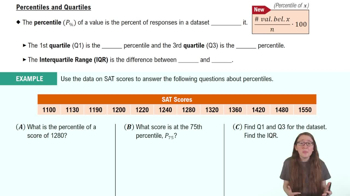
The first quartile (Q1) represents the 25th percentile, meaning 25% of the data falls below this value.
The second quartile (Q2) is the median, representing the 50th percentile, where half of the data lies below and half above.
The third quartile (Q3) represents the 75th percentile, indicating that 75% of the data is below this value and 25% is above.
Together, these quartiles help describe the spread and distribution of the data, highlighting where the middle 50% of the data lies between Q1 and Q3.
Verified video answer for a similar problem:This video solution was recommended by our tutors as helpful for the problem above
Video duration:
1mPlay a video:
Was this helpful?
Key Concepts
Here are the essential concepts you must grasp in order to answer the question correctly.
Quartiles
Quartiles divide a data set into four equal parts after the data is sorted. Each quartile marks a boundary that separates the data into 25% segments, helping to understand the distribution and spread of the data.
Recommended video:
Percentiles and Quartiles
First Quartile (Q1)
The first quartile (Q1) is the value below which 25% of the data falls. It represents the lower boundary of the middle 50% of the data and helps identify the lower range of the data set.
Recommended video:
Percentiles and Quartiles
Second and Third Quartiles (Q2 and Q3)
The second quartile (Q2) is the median, dividing the data into two equal halves. The third quartile (Q3) marks the value below which 75% of the data lies, indicating the upper boundary of the middle 50% of the data.
Recommended video:
Percentiles and Quartiles
Watch next
Master Percentiles and Quartiles with a bite sized video explanation from Patrick
Start learningRelated Videos
Related Practice
Textbook Question
2
views