Explain what each quartile represents.
Table of contents
- 1. Intro to Stats and Collecting Data1h 14m
- 2. Describing Data with Tables and Graphs1h 55m
- 3. Describing Data Numerically2h 5m
- 4. Probability2h 16m
- 5. Binomial Distribution & Discrete Random Variables3h 6m
- 6. Normal Distribution and Continuous Random Variables2h 11m
- 7. Sampling Distributions & Confidence Intervals: Mean3h 23m
- Sampling Distribution of the Sample Mean and Central Limit Theorem19m
- Distribution of Sample Mean - Excel23m
- Introduction to Confidence Intervals15m
- Confidence Intervals for Population Mean1h 18m
- Determining the Minimum Sample Size Required12m
- Finding Probabilities and T Critical Values - Excel28m
- Confidence Intervals for Population Means - Excel25m
- 8. Sampling Distributions & Confidence Intervals: Proportion1h 25m
- 9. Hypothesis Testing for One Sample3h 29m
- 10. Hypothesis Testing for Two Samples4h 50m
- Two Proportions1h 13m
- Two Proportions Hypothesis Test - Excel28m
- Two Means - Unknown, Unequal Variance1h 3m
- Two Means - Unknown Variances Hypothesis Test - Excel12m
- Two Means - Unknown, Equal Variance15m
- Two Means - Unknown, Equal Variances Hypothesis Test - Excel9m
- Two Means - Known Variance12m
- Two Means - Sigma Known Hypothesis Test - Excel21m
- Two Means - Matched Pairs (Dependent Samples)42m
- Matched Pairs Hypothesis Test - Excel12m
- 11. Correlation1h 24m
- 12. Regression1h 50m
- 13. Chi-Square Tests & Goodness of Fit2h 21m
- 14. ANOVA1h 57m
3. Describing Data Numerically
Percentiles & Quartiles
Problem 3.2.4
Textbook Question
True or False: Chebyshev’s Inequality applies to all distributions regardless of shape, but the Empirical Rule holds only for distributions that are bell shaped.
Verified step by step guidance1
Understand the statement: Chebyshev’s Inequality provides a bound on the proportion of values that lie within a certain number of standard deviations from the mean, and it applies to any distribution regardless of its shape.
Recall that Chebyshev’s Inequality states that for any distribution and any \(k > 1\), at least \$1 - \frac{1}{k^2}\( of the data lies within \)k$ standard deviations of the mean, expressed as:
\[ P(|X - \mu| < k\sigma) \geq 1 - \frac{1}{k^2} \]
Recognize that the Empirical Rule (or 68-95-99.7 rule) specifically applies to normal (bell-shaped) distributions and gives approximate percentages of data within 1, 2, and 3 standard deviations from the mean.
The Empirical Rule states: about 68% of data lies within 1 standard deviation, 95% within 2, and 99.7% within 3 standard deviations, but this only holds accurately for bell-shaped (normal) distributions.
Therefore, the statement is True because Chebyshev’s Inequality is universal for all distributions, while the Empirical Rule is valid only for bell-shaped distributions.
Verified video answer for a similar problem:This video solution was recommended by our tutors as helpful for the problem above
Video duration:
2mPlay a video:
Was this helpful?
Key Concepts
Here are the essential concepts you must grasp in order to answer the question correctly.
Chebyshev’s Inequality
Chebyshev’s Inequality provides a minimum proportion of data within a certain number of standard deviations from the mean, regardless of the distribution's shape. It applies to all distributions, making no assumptions about normality, and guarantees that at least 1 - 1/k² of data lies within k standard deviations.
Recommended video:
Finding Poisson Probabilities Using TI-84
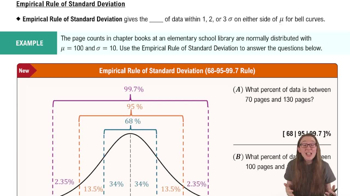
Empirical Rule
The Empirical Rule states that for bell-shaped (normal) distributions, approximately 68%, 95%, and 99.7% of data fall within 1, 2, and 3 standard deviations from the mean, respectively. This rule relies on the assumption of normality and does not hold for distributions that are skewed or have different shapes.
Recommended video:
Empirical Rule of Standard Deviation and Range Rule of Thumb
Distribution Shape and Its Impact on Statistical Rules
The shape of a distribution affects which statistical rules apply. While Chebyshev’s Inequality is universal, rules like the Empirical Rule depend on the distribution being bell-shaped (normal). Understanding distribution shape helps determine the appropriate methods for data analysis and interpretation.
Recommended video:
Conditional Probability Rule
Watch next
Master Percentiles and Quartiles with a bite sized video explanation from Patrick
Start learningRelated Videos
Related Practice
Textbook Question
4
views