3. What does the sample correlation coefficient r measure? Which value indicates a stronger correlation: r =0.918 or r =- 0.932? Explain your reasoning.
Table of contents
- 1. Intro to Stats and Collecting Data1h 14m
- 2. Describing Data with Tables and Graphs1h 55m
- 3. Describing Data Numerically2h 5m
- 4. Probability2h 16m
- 5. Binomial Distribution & Discrete Random Variables3h 6m
- 6. Normal Distribution and Continuous Random Variables2h 11m
- 7. Sampling Distributions & Confidence Intervals: Mean3h 23m
- Sampling Distribution of the Sample Mean and Central Limit Theorem19m
- Distribution of Sample Mean - Excel23m
- Introduction to Confidence Intervals15m
- Confidence Intervals for Population Mean1h 18m
- Determining the Minimum Sample Size Required12m
- Finding Probabilities and T Critical Values - Excel28m
- Confidence Intervals for Population Means - Excel25m
- 8. Sampling Distributions & Confidence Intervals: Proportion1h 25m
- 9. Hypothesis Testing for One Sample3h 29m
- 10. Hypothesis Testing for Two Samples4h 50m
- Two Proportions1h 13m
- Two Proportions Hypothesis Test - Excel28m
- Two Means - Unknown, Unequal Variance1h 3m
- Two Means - Unknown Variances Hypothesis Test - Excel12m
- Two Means - Unknown, Equal Variance15m
- Two Means - Unknown, Equal Variances Hypothesis Test - Excel9m
- Two Means - Known Variance12m
- Two Means - Sigma Known Hypothesis Test - Excel21m
- Two Means - Matched Pairs (Dependent Samples)42m
- Matched Pairs Hypothesis Test - Excel12m
- 11. Correlation1h 24m
- 12. Regression1h 50m
- 13. Chi-Square Tests & Goodness of Fit2h 21m
- 14. ANOVA1h 57m
11. Correlation
Correlation Coefficient
Problem 11.4.1
Textbook Question
What are some advantages of the Spearman rank correlation coefficient over the Pearson correlation coefficient?
Verified step by step guidance1
The Spearman rank correlation coefficient is a non-parametric measure, meaning it does not assume that the data follows a specific distribution (e.g., normal distribution), unlike the Pearson correlation coefficient which assumes linearity and normality.
Spearman rank correlation is based on the ranks of the data rather than the raw data values, making it more robust to outliers and extreme values compared to Pearson correlation.
Spearman correlation can capture monotonic relationships (where variables move in the same or opposite direction, but not necessarily at a constant rate), while Pearson correlation is limited to linear relationships.
Spearman rank correlation can be used with ordinal data (data that can be ranked but not measured precisely), whereas Pearson correlation requires interval or ratio data.
Spearman rank correlation is less sensitive to measurement errors in the data, especially when the errors do not affect the ranking of the data points.
Verified video answer for a similar problem:This video solution was recommended by our tutors as helpful for the problem above
Video duration:
2mPlay a video:
Was this helpful?
Key Concepts
Here are the essential concepts you must grasp in order to answer the question correctly.
Spearman Rank Correlation Coefficient
The Spearman rank correlation coefficient is a non-parametric measure of correlation that assesses how well the relationship between two variables can be described by a monotonic function. Unlike Pearson's correlation, which measures linear relationships, Spearman's method ranks the data and evaluates the strength and direction of the association based on these ranks, making it suitable for ordinal data or non-normally distributed interval data.
Recommended video:
Guided course
Correlation Coefficient
Pearson Correlation Coefficient
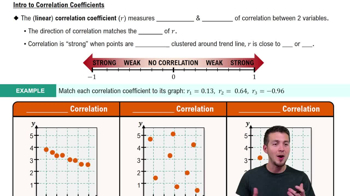
The Pearson correlation coefficient is a parametric statistic that measures the linear relationship between two continuous variables. It assumes that the data is normally distributed and that the relationship is linear. This coefficient provides a value between -1 and 1, where values close to 1 indicate a strong positive linear relationship, values close to -1 indicate a strong negative linear relationship, and values around 0 suggest no linear correlation.
Recommended video:
Guided course
Correlation Coefficient
Non-parametric vs. Parametric Tests
Non-parametric tests, like the Spearman rank correlation, do not assume a specific distribution for the data and are often used when data does not meet the assumptions required for parametric tests, such as normality. Parametric tests, like the Pearson correlation, rely on these assumptions and are generally more powerful when the assumptions are met. Understanding the differences helps in choosing the appropriate statistical method based on the data characteristics.
Recommended video:
Guided course
Parameters vs. Statistics
Watch next
Master Correlation Coefficient with a bite sized video explanation from Patrick
Start learningRelated Videos
Related Practice
Textbook Question
53
views