What does it mean when rs is equal to 1? What does it mean when rs is equal to ? What does it mean when rs is equal to 0?
Verified step by step guidance
1
Understand that 'rs' refers to the Spearman rank correlation coefficient, which measures the strength and direction of a monotonic relationship between two variables.
When rs = 1, it means there is a perfect positive monotonic relationship between the two variables. This implies that as one variable increases, the other variable also increases in a perfectly consistent manner.
When rs = -1, it means there is a perfect negative monotonic relationship between the two variables. This implies that as one variable increases, the other variable decreases in a perfectly consistent manner.
When rs = 0, it means there is no monotonic relationship between the two variables. This does not necessarily mean there is no relationship at all, but rather that the relationship is not monotonic (e.g., it could be non-linear).
To summarize, the value of rs ranges from -1 to 1, where values closer to -1 or 1 indicate stronger monotonic relationships, and a value of 0 indicates no monotonic relationship.
Verified video answer for a similar problem:
This video solution was recommended by our tutors as helpful for the problem above.
Video duration:
2m
Play a video:
0 Comments
Key Concepts
Here are the essential concepts you must grasp in order to answer the question correctly.
Spearman's Rank Correlation Coefficient (rs)
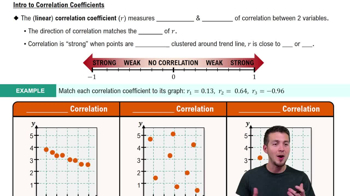
Spearman's rank correlation coefficient (rs) is a non-parametric measure that assesses the strength and direction of association between two ranked variables. It evaluates how well the relationship between the variables can be described using a monotonic function. Values of rs range from -1 to 1, indicating perfect negative correlation, no correlation, and perfect positive correlation, respectively.
When rs equals 1, it indicates a perfect positive correlation between the two variables. This means that as one variable increases, the other variable also increases in a perfectly linear manner. In practical terms, all data points lie on a straight line with a positive slope, suggesting a strong and consistent relationship.
Empirical Rule of Standard Deviation and Range Rule of Thumb
Interpretation of rs = 0
An rs value of 0 signifies no correlation between the two variables, indicating that changes in one variable do not predict changes in the other. This lack of correlation means that the variables are independent of each other, and there is no discernible pattern in their relationship. It is important to note that this does not imply that the variables are unrelated in all contexts, just that there is no monotonic relationship.

 2:13 minutes
 Verified step by step guidance
 05:43
05:43