In Section 10.2, we tested hypotheses regarding a population proportion using a z-test. However, we can also use the chi-square goodness-of-fit test to test hypotheses with k = 2 possible outcomes. In Problems 25 and 26, we test hypotheses with the use of both methods. Low Birth Weight According to the U.S. Census Bureau, 7.1% of all babies born are of low birth weight . An obstetrician wanted to know whether mothers between the ages of 35 and 39 years give birth to a higher percentage of low-birth-weight babies. She randomly selected 240 births for which the mother was 35 to 39 years old and found 22 low-birth-weight babies.
a. If the proportion of low-birth-weight babies for mothers in this age group is 0.071, compute the expected number of low-birth-weight births to 35- to 39-year-old mothers. What is the expected number of births to mothers 35 to 39 years old that are not low birth weight?
Verified step by step guidance
1
Identify the total number of births in the sample, which is given as 240.
Use the hypothesized population proportion of low-birth-weight babies, which is 0.071, to calculate the expected number of low-birth-weight births. This is done by multiplying the total number of births by the proportion: \(\text{Expected low-birth-weight} = 240 \times 0.071\).
Calculate the expected number of births that are not low birth weight by subtracting the expected low-birth-weight births from the total births, or equivalently, multiply the total births by the complement of the proportion: \(\text{Expected not low-birth-weight} = 240 \times (1 - 0.071)\).
Summarize the expected counts for both categories: low birth weight and not low birth weight, which will be used in further hypothesis testing.
Ensure that the expected counts satisfy the conditions for the chi-square test (usually each expected count should be at least 5) before proceeding with the test.
Verified video answer for a similar problem:
This video solution was recommended by our tutors as helpful for the problem above
Video duration:
1m
Play a video:
0 Comments
Key Concepts
Here are the essential concepts you must grasp in order to answer the question correctly.
Population Proportion
The population proportion is the fraction of the population that has a particular characteristic, such as low birth weight in babies. It is denoted by p and represents the true proportion in the entire population. In hypothesis testing, this value is often the baseline or null hypothesis proportion to compare sample data against.
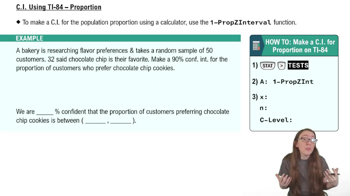
Finding a Confidence Interval for a Population Proportion Using a TI84
Expected Frequency in Hypothesis Testing
Expected frequency refers to the number of observations we anticipate in each category if the null hypothesis is true. It is calculated by multiplying the total sample size by the hypothesized population proportion. Expected counts are essential for tests like the chi-square goodness-of-fit to assess how observed data align with expectations.
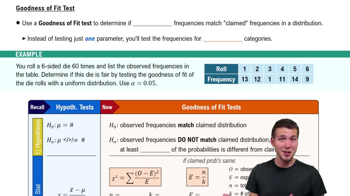
Chi-Square Goodness-of-Fit Test with Two Categories
The chi-square goodness-of-fit test evaluates whether observed categorical data fit a specified distribution. When there are two categories (e.g., low birth weight and not low birth weight), it tests if the observed counts differ significantly from expected counts under the null hypothesis. This test is an alternative to the z-test for proportions.