High School Dropouts According to the U.S. Census Bureau, 8.0% of 16- to 24-year-olds are high school dropouts. In addition, 2.1% of 16- to 24-year-olds are high school dropouts and unemployed. What is the probability that a randomly selected 16- to 24-year-old is unemployed, given he or she is a dropout?
Table of contents
- 1. Intro to Stats and Collecting Data1h 14m
- 2. Describing Data with Tables and Graphs1h 55m
- 3. Describing Data Numerically2h 5m
- 4. Probability2h 16m
- 5. Binomial Distribution & Discrete Random Variables3h 6m
- 6. Normal Distribution and Continuous Random Variables2h 11m
- 7. Sampling Distributions & Confidence Intervals: Mean3h 23m
- Sampling Distribution of the Sample Mean and Central Limit Theorem19m
- Distribution of Sample Mean - Excel23m
- Introduction to Confidence Intervals15m
- Confidence Intervals for Population Mean1h 18m
- Determining the Minimum Sample Size Required12m
- Finding Probabilities and T Critical Values - Excel28m
- Confidence Intervals for Population Means - Excel25m
- 8. Sampling Distributions & Confidence Intervals: Proportion1h 25m
- 9. Hypothesis Testing for One Sample3h 29m
- 10. Hypothesis Testing for Two Samples4h 50m
- Two Proportions1h 13m
- Two Proportions Hypothesis Test - Excel28m
- Two Means - Unknown, Unequal Variance1h 3m
- Two Means - Unknown Variances Hypothesis Test - Excel12m
- Two Means - Unknown, Equal Variance15m
- Two Means - Unknown, Equal Variances Hypothesis Test - Excel9m
- Two Means - Known Variance12m
- Two Means - Sigma Known Hypothesis Test - Excel21m
- Two Means - Matched Pairs (Dependent Samples)42m
- Matched Pairs Hypothesis Test - Excel12m
- 11. Correlation1h 24m
- 12. Regression1h 50m
- 13. Chi-Square Tests & Goodness of Fit2h 21m
- 14. ANOVA1h 57m
4. Probability
Multiplication Rule: Dependent Events
Problem 5.4.29c
Textbook Question
"Planting Tulips
A bag of 30 tulip bulbs purchased from a nursery contains 12 red tulip bulbs, 10 yellow tulip bulbs, and 8 purple tulip bulbs. Use a tree diagram like the one in Example 5 to answer the following:
c. What is the probability that the first bulb selected is yellow and the second is red?
"
Verified step by step guidance1
Identify the total number of tulip bulbs in the bag. Since there are 12 red, 10 yellow, and 8 purple bulbs, the total is \$12 + 10 + 8 = 30$ bulbs.
Determine the probability of selecting a yellow bulb first. This is the number of yellow bulbs divided by the total number of bulbs, so \(P(\text{first yellow}) = \frac{10}{30}\).
After selecting one yellow bulb, update the total number of bulbs remaining. Since one bulb is taken out, the new total is \$30 - 1 = 29$ bulbs.
Determine the probability of selecting a red bulb second, given that the first bulb was yellow. The number of red bulbs remains 12, so \(P(\text{second red} \mid \text{first yellow}) = \frac{12}{29}\).
Calculate the combined probability of both events happening in sequence by multiplying the probabilities: \(P(\text{first yellow and second red}) = P(\text{first yellow}) \times P(\text{second red} \mid \text{first yellow}) = \frac{10}{30} \times \frac{12}{29}\).
Verified video answer for a similar problem:This video solution was recommended by our tutors as helpful for the problem above
Video duration:
3mPlay a video:
Was this helpful?
Key Concepts
Here are the essential concepts you must grasp in order to answer the question correctly.
Probability of Sequential Events
This concept involves calculating the likelihood of multiple events happening in a specific order. When selecting bulbs one after another without replacement, the outcome of the first event affects the second. The overall probability is found by multiplying the probability of the first event by the conditional probability of the second event.
Recommended video:
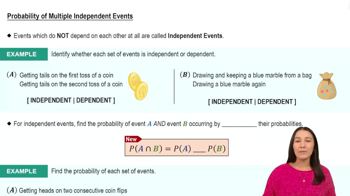
Probability of Multiple Independent Events
Conditional Probability
Conditional probability measures the chance of an event occurring given that another event has already happened. In this problem, after selecting the first bulb, the total number of bulbs changes, which affects the probability of selecting the second bulb. Understanding this helps adjust probabilities based on updated sample sizes.
Recommended video:
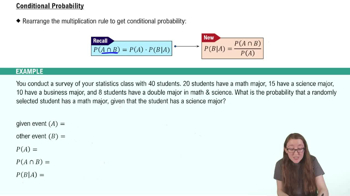
Conditional Probability Rule
Tree Diagram
A tree diagram is a visual tool that maps out all possible outcomes of sequential events and their probabilities. It helps organize and calculate combined probabilities by branching out each event step-by-step. Using a tree diagram clarifies complex probability problems by showing all paths and their associated probabilities.
Recommended video:
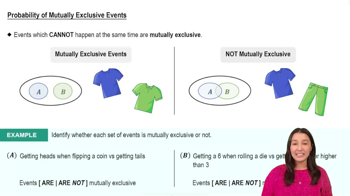
Probability of Mutually Exclusive Events
Watch next
Master Multiplication Rule: Dependent Events with a bite sized video explanation from Patrick
Start learningRelated Videos
Related Practice
Textbook Question
19
views