Graphical Analysis In Exercises 13 and 14, use the box-and-whisker plot to identify the five-number summary.
Table of contents
- 1. Intro to Stats and Collecting Data1h 14m
- 2. Describing Data with Tables and Graphs1h 55m
- 3. Describing Data Numerically2h 5m
- 4. Probability2h 16m
- 5. Binomial Distribution & Discrete Random Variables3h 6m
- 6. Normal Distribution and Continuous Random Variables2h 11m
- 7. Sampling Distributions & Confidence Intervals: Mean3h 23m
- Sampling Distribution of the Sample Mean and Central Limit Theorem19m
- Distribution of Sample Mean - Excel23m
- Introduction to Confidence Intervals15m
- Confidence Intervals for Population Mean1h 18m
- Determining the Minimum Sample Size Required12m
- Finding Probabilities and T Critical Values - Excel28m
- Confidence Intervals for Population Means - Excel25m
- 8. Sampling Distributions & Confidence Intervals: Proportion1h 25m
- 9. Hypothesis Testing for One Sample3h 29m
- 10. Hypothesis Testing for Two Samples4h 50m
- Two Proportions1h 13m
- Two Proportions Hypothesis Test - Excel28m
- Two Means - Unknown, Unequal Variance1h 3m
- Two Means - Unknown Variances Hypothesis Test - Excel12m
- Two Means - Unknown, Equal Variance15m
- Two Means - Unknown, Equal Variances Hypothesis Test - Excel9m
- Two Means - Known Variance12m
- Two Means - Sigma Known Hypothesis Test - Excel21m
- Two Means - Matched Pairs (Dependent Samples)42m
- Matched Pairs Hypothesis Test - Excel12m
- 11. Correlation1h 24m
- 12. Regression1h 50m
- 13. Chi-Square Tests & Goodness of Fit2h 21m
- 14. ANOVA1h 57m
3. Describing Data Numerically
Boxplots
Problem 11.3A.5d
Textbook Question
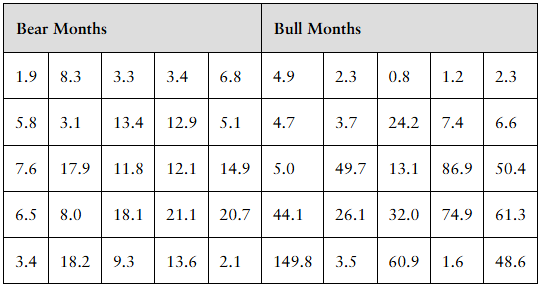
[DATA] Bull and Bear Markets The stock market goes through periods known as bull markets and bear markets. A bull market exists when the stock market increases in value by at least 20%, while a bear market exists when the stock market decreases in value by at least 20%. The data below represent the number of months a random sample of bull and bear markets have lasted.
d. Draw a side-by-side boxplot by market condition. Discuss any interesting features of the graph.

Verified step by step guidance1
Step 1: Organize the data into two groups based on market condition: Bear Months and Bull Months, as given in the table.
Step 2: For each group, calculate the five-number summary: minimum, first quartile (Q1), median (Q2), third quartile (Q3), and maximum. These values are essential for constructing boxplots.
Step 3: Draw the boxplot for each group side-by-side on the same scale. Each boxplot should have a box from Q1 to Q3, a line at the median, and whiskers extending to the minimum and maximum values (or to the nearest non-outlier values if you identify outliers).
Step 4: Compare the two boxplots by examining their medians, interquartile ranges (IQR = Q3 - Q1), overall range, and any potential outliers. Note differences in central tendency, spread, and skewness between bear and bull market durations.
Step 5: Discuss interesting features such as which market tends to last longer, which has more variability, and whether there are any extreme values or outliers that might affect interpretation.
Verified video answer for a similar problem:This video solution was recommended by our tutors as helpful for the problem above
Video duration:
2mPlay a video:
Was this helpful?
Key Concepts
Here are the essential concepts you must grasp in order to answer the question correctly.
Boxplot Construction and Interpretation
A boxplot visually summarizes data distribution through five key statistics: minimum, first quartile (Q1), median, third quartile (Q3), and maximum. It highlights the central tendency, spread, and potential outliers, making it easier to compare groups side-by-side, such as bear and bull market durations.
Recommended video:
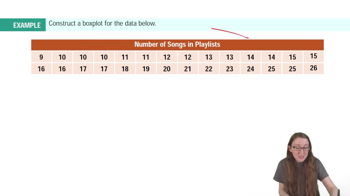
Boxplots Example 1
Comparing Distributions
Comparing distributions involves analyzing differences in shape, center, spread, and outliers between groups. Side-by-side boxplots allow direct visual comparison of these features, helping to identify which market condition tends to last longer or has more variability.
Recommended video:
Guided course
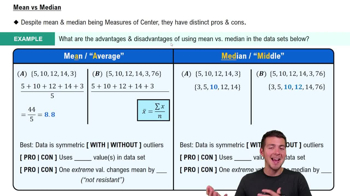
Comparing Mean vs. Median
Understanding Market Conditions and Data Context
Bull and bear markets represent periods of rising and falling stock values, respectively, with durations measured in months. Understanding this context helps interpret the data meaningfully, such as recognizing that longer bull markets might indicate sustained growth phases, while bear markets may be shorter but more volatile.
Recommended video:
Introduction to Collecting Data
Watch next
Master Boxplots ("Box and Whisker Plots") with a bite sized video explanation from Patrick
Start learningRelated Videos
Related Practice
Textbook Question
43
views